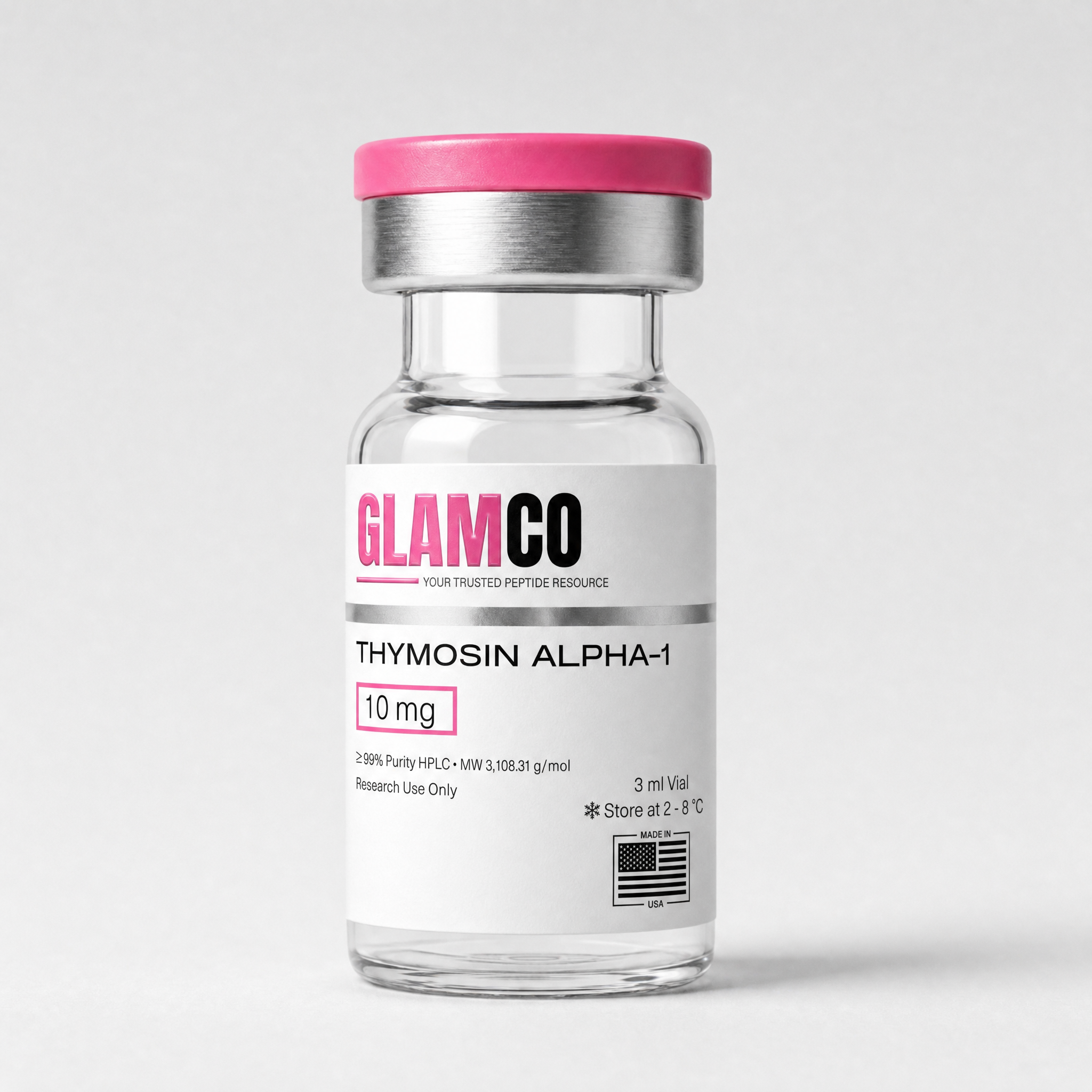
GlamCO Thymosin Alpha-1
99%+ Purity
Verified by HPLC
Home / Catalog / Thymosin Alpha-1

Thymosin Alpha-1

$85.00
Made in USA
cGMP Compliant

Thymosin Alpha-1 (Talpha1) is a synthetic 28-amino-acid N-acetylated peptide identical to a fragment of thymic thymosin, supplied as a lyophilized powder for in vitro T-cell maturation, dendritic-cell, and TLR9/MyD88 signaling research. Research use only.

TierQuantityDiscount
Most Popular3 - 510%
Max Savings6 +15%
Secure Checkout | Third-Party Tested | Free Shipping $100+
Sterility & Endotoxins PASSED
Net Content & Purity PASSED
Third-Party Lab Verified

Independently Tested. Verifiably Pure.

Every batch of Thymosin Alpha-1 is sent to an accredited independent laboratory before it ships. Here is exactly what we screen for - and the certificate that proves it.

What We Test Every Batch For
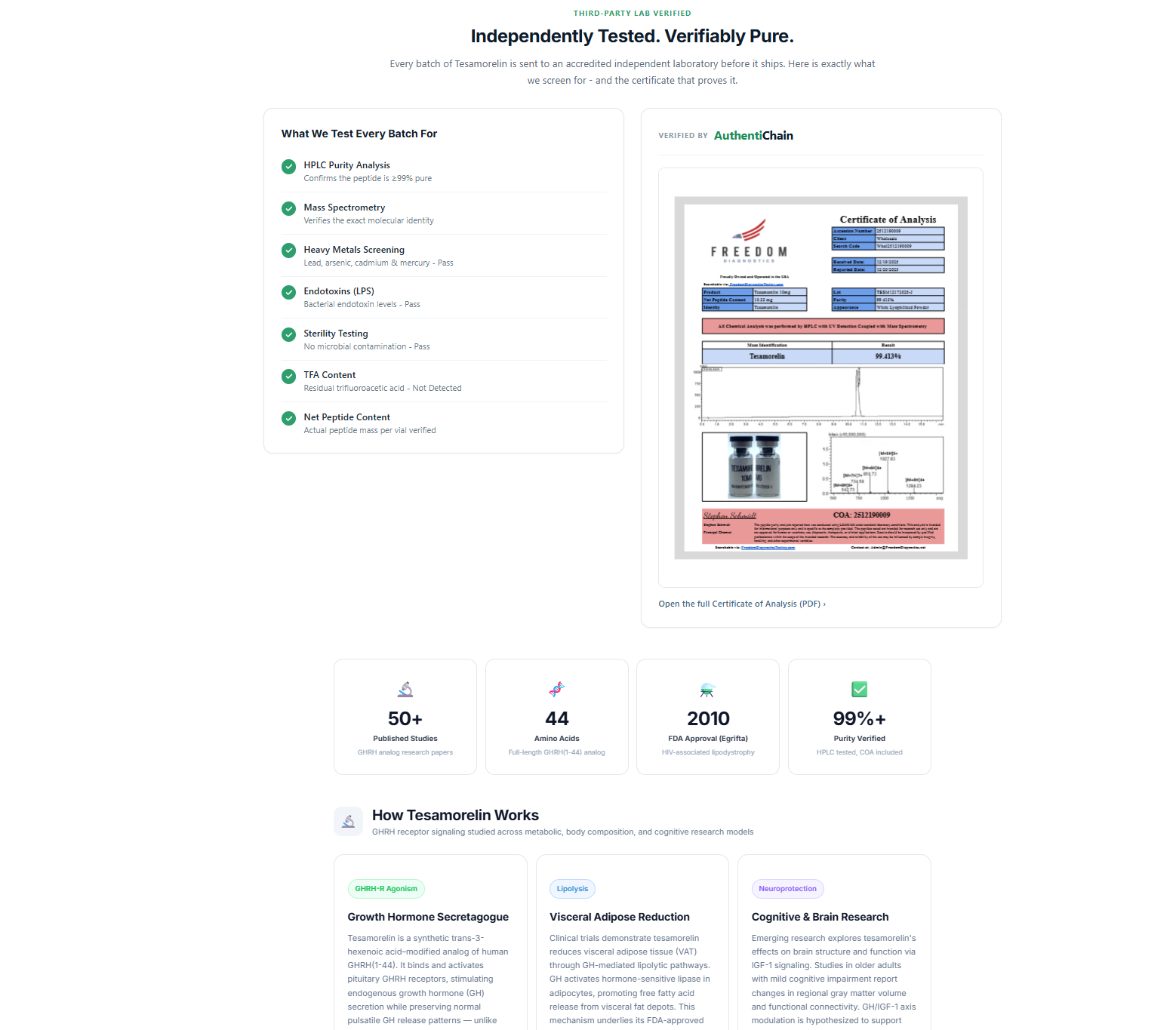
HPLC Purity Analysis
Confirms the peptide is ≥99% pure
Mass Spectrometry
Verifies molecular identity (MW ~3108 Da, N-acetylated 28-mer)
Heavy Metals Screening
Lead, arsenic, cadmium & mercury - Pass
Endotoxins (LPS)
Bacterial endotoxin levels - Pass
Sterility Testing
No microbial contamination - Pass
TFA Content
Residual trifluoroacetic acid - Not Detected
Net Peptide Content
Actual peptide mass per vial verified
🧬
28
Amino Acids
N-acetylated 28-mer
⚖️
3108
Molecular Weight (Da)
C₁₂₉H₂₁₅N₃₃O₅₅
📅
1977
Goldstein Group
Originally isolated from thymosin fraction 5
🛡️
99%+
Purity Verified
HPLC tested, COA included
Preclinical Mechanism (Hypothesized)

How Thymosin Alpha-1 Works

Proposed in vitro mechanisms drawn from the preclinical immunology literature on thymic peptides. Findings are from cell-culture and animal-model research; do not interpret as clinical effect.

Innate Immune Signaling Research

TLR9 / MyD88 Signaling

In preclinical in vitro work, Thymosin Alpha-1 has been reported to engage Toll-like receptor 9 (TLR9) on dendritic cells and downstream MyD88 adaptor signaling, leading to NF-κB activation and cytokine output in research models (Romani et al., 2004; Pierluigi et al., 2010).

  • Reported TLR9-dependent dendritic-cell activation in vitro
  • MyD88 adaptor recruitment and NF-κB signaling reported
  • Mechanism described in cell-culture systems only
T-Cell / Dendritic-Cell Maturation Research

T-Cell & Dendritic-Cell Maturation Research

Cell-culture studies report that Thymosin Alpha-1 promotes maturation of thymocytes and dendritic cells, supports CD4+/CD8+ T-cell differentiation, and modulates antigen-presenting cell phenotype. These observations frame Talpha1 as a research tool for thymic and adaptive-immunity in vitro models.

  • Promotes T-cell maturation in thymocyte cultures
  • Drives dendritic-cell maturation markers in vitro
  • Used as a probe of adaptive immunity development
Cytokine Pathway Research

Th1 Cytokine Response Modulation

Preclinical research reports increased IFN-γ and IL-2 output and a shift toward a Th1-skewed cytokine profile in T-cell and PBMC cultures exposed to Thymosin Alpha-1. Used as a model peptide for studying Th1 polarization and antiviral cytokine pathways in vitro.

  • Reported IFN-γ / IL-2 upregulation in cultured cells
  • Th1-skewed cytokine profile in PBMC research models
  • Probe for antiviral cytokine signaling pathways
Preclinical Outcomes

What Research Has Shown

Selected qualitative effect summaries from preclinical Talpha1 cell-culture and animal-model literature.

TLR9 / MyD88-Dependent Dendritic Cell Activation (Romani et al. 2004) Reported
T-Cell Maturation Markers in Thymocyte Cultures (Goldstein et al.) Increased
IFN-γ Output in PBMC Cultures (preclinical reviews) Upregulated
Th1-Skewed Cytokine Profile in T-Cell Cultures Observed
Investigational Fields

Research Applications

Primary in vitro and preclinical research domains for Thymosin Alpha-1

Immune Cell Biology

Immune Cell Biology

Used as a probe in thymocyte, T-cell, and dendritic-cell cultures to study lymphocyte maturation, antigen presentation, and adaptive immunity development in research models.

Garaci et al. 2007 ↗
TLR Signaling Research

TLR Signaling Research

Applied in dendritic-cell and macrophage cultures as a research peptide to interrogate TLR9 engagement, MyD88 adapter dynamics, and downstream NF-κB signaling.

Romani et al. 2004 ↗
Antiviral Pathway Studies

Antiviral Pathway Preclinical Studies

Investigated in viral-infection cell-culture and animal models as a tool peptide for examining innate antiviral signaling and interferon-pathway dynamics in research settings.

Pierluigi et al. 2010 ↗
Cytokine Modulation Research

Cytokine Modulation Research

Used in PBMC and T-cell culture systems as a reference compound for Th1 cytokine modulation studies, including IFN-γ and IL-2 output in vitro.

King et al. 2012 ↗
Technical Specifications

Compound Information

Technical specifications and analytical profile

Common Names
Thymosin Alpha-1, Talpha1, Tα1, Thymalfasin (international trade name: Zadaxin)
Sequence
SDAAVDTSSEITTKDLKEKKEVVEEAEN (28 amino acids, N-terminally acetylated)
Molecular Weight
~3108 Da
Molecular Formula
C₁₂₉H₂₁₅N₃₃O₅₅
CAS Number
62304-98-7
Form
Lyophilized powder
Purity
≥99% (HPLC verified)
Testing
Third-party HPLC, Mass Spec, Endotoxin
Storage (lyophilized)
-20°C for long-term stability
Storage (reconstituted)
2-8°C, use within 14 days
Solubility
Bacteriostatic water for reconstitution
COA
Included with every order
Common Inquiries

Frequently Asked Questions

Common questions about Thymosin Alpha-1 research parameters

Thymosin Alpha-1 (Talpha1, thymalfasin) is a synthetic 28-amino-acid peptide with the sequence SDAAVDTSSEITTKDLKEKKEVVEEAEN, identical to a fragment of thymosin originally isolated by Goldstein and colleagues from thymosin fraction 5 of bovine thymus. The molecule carries an N-terminal acetylation. It is marketed internationally as the trade name Zadaxin for clinical investigations; this product is supplied strictly as a lyophilized research peptide for in vitro and preclinical use only.
Cell-culture work from Romani, Pierluigi and colleagues reports that Thymosin Alpha-1 activates dendritic cells via TLR9 and the MyD88 adaptor pathway, producing downstream NF-κB activation and altered cytokine output. These findings are in vitro mechanistic observations and do not establish clinical activity.
Yes - the preclinical literature includes animal-model studies of Talpha1 in viral and fungal infection contexts, examining innate-immune cell activation, cytokine modulation, and adaptive-immune cell recruitment. These remain preclinical animal-model findings and are not interchangeable with human clinical outcomes.
Zadaxin is the international clinical trade name for thymalfasin, a pharmaceutical preparation of synthetic Thymosin Alpha-1 evaluated in clinical trials outside the United States. Our material is sold solely as a research peptide for in vitro and preclinical investigation and is not the Zadaxin clinical product.
Lyophilized Thymosin Alpha-1 should be stored at -20°C for long-term stability and protected from light. Once reconstituted in bacteriostatic water, refrigerate at 2-8°C and use within 14 days. Avoid repeated freeze-thaw cycles.
No. Thymosin Alpha-1 is not approved by the FDA for human therapeutic use. Thymalfasin (Zadaxin) is approved in certain non-US jurisdictions as a clinical pharmaceutical, but that is a separately manufactured clinical product. Material listed on this page is sold strictly as a research chemical for in vitro and preclinical investigation; it is not a drug, supplement, or cosmetic.
Academic Literature

Sources & References

Selected peer-reviewed publications on Thymosin Alpha-1
PUBMED

Thymosin alpha 1 activates dendritic cells for antifungal Th1 resistance through TLR signaling

2004 · Romani L et al. · Blood · PMID 15356133
View Source ↗
PUBMED

Thymosin alpha 1: from bench to bedside (review of preclinical immunology)

2007 · Garaci E et al. · Ann N Y Acad Sci · PMID 17559353
View Source ↗
PUBMED

Thymosin alpha-1 enhances dendritic cell response in preclinical antiviral models

2010 · Pierluigi B et al. · Ann N Y Acad Sci · PMID 20146697
View Source ↗
PUBMED

Thymosin alpha-1 immunomodulation and Toll-like receptor signaling in preclinical immunology

2012 · King R et al. · Front Immunol / Ann N Y Acad Sci · PMID 22708987
View Source ↗