
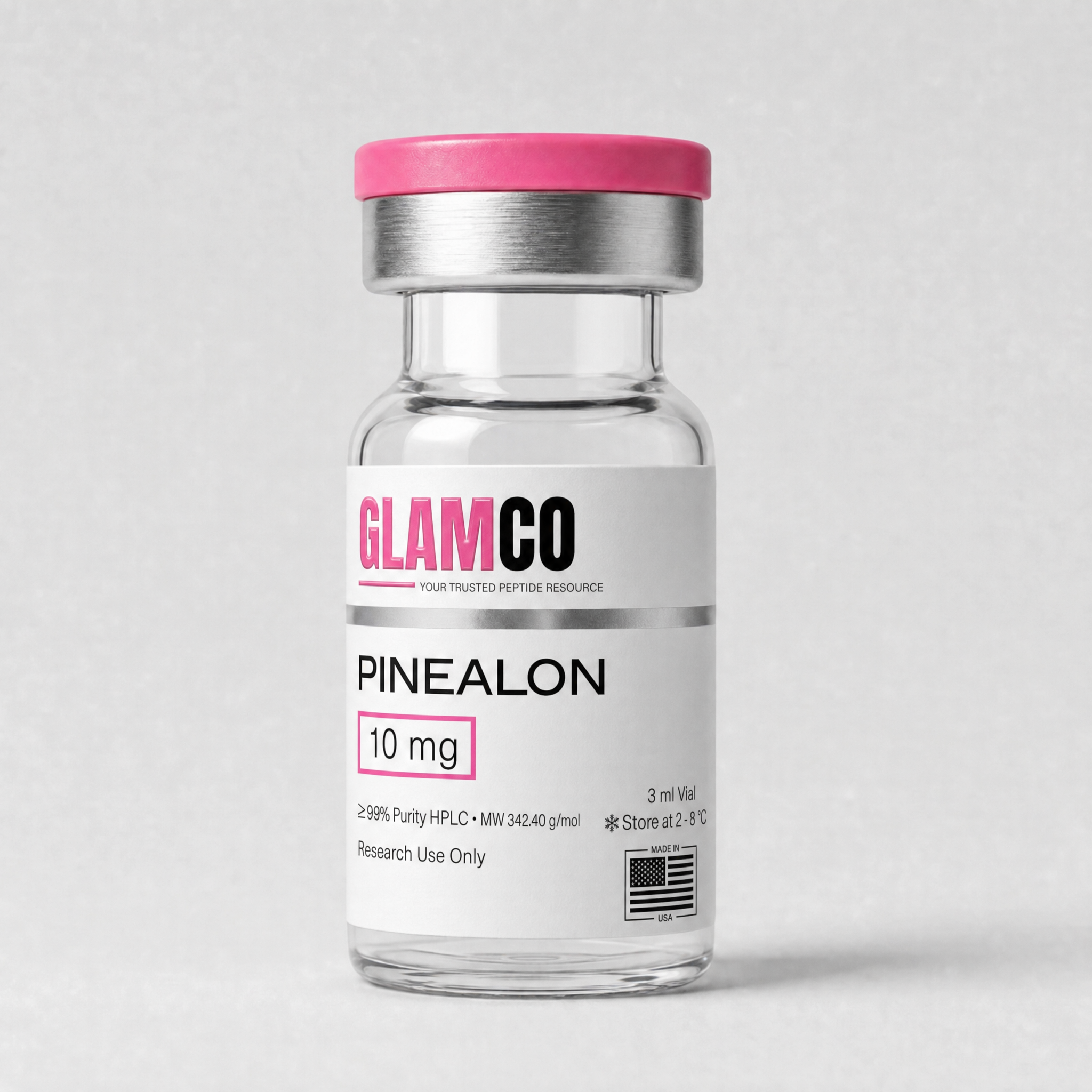
GlamCO Pinealon
99%+ Purity
Verified by HPLC
Home / Catalog / Pinealon

Pinealon

$65.00
Made in USA
cGMP Compliant

Pinealon (Glu-Asp-Arg / EDR) Khavinson tripeptide bioregulator for in vitro neuroprotection-pathway research.

Tier Quantity Discount
Most Popular 3 - 5 10%
Max Savings 6 + 15%
Secure Checkout | Third-Party Tested | Free Shipping $100+
Sterility & Endotoxins PASSED
Net Content & Purity PASSED
Third-Party Lab Verified

Independently Tested. Verifiably Pure.

Every batch of Pinealon is sent to an accredited independent laboratory before it ships. Here is exactly what we screen for - and the certificate that proves it.

What We Test Every Batch For
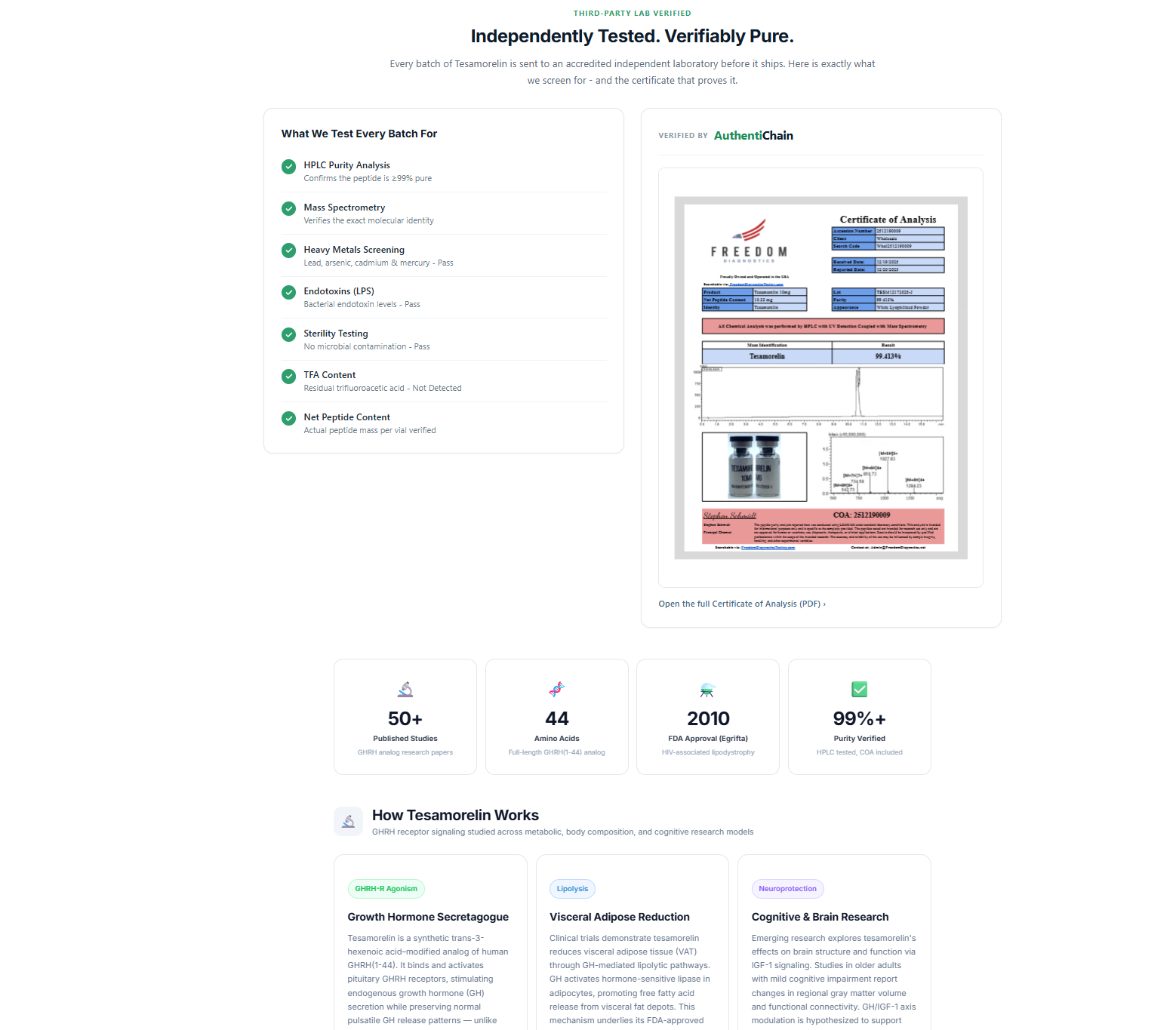
HPLC Purity Analysis
Confirms the peptide is ≥99% pure
Mass Spectrometry
Verifies the exact molecular identity
Heavy Metals Screening
Lead, arsenic, cadmium & mercury - Pass
Endotoxins (LPS)
Bacterial endotoxin levels - Pass
Sterility Testing
No microbial contamination - Pass
TFA Content
Residual trifluoroacetic acid - Not Detected
Net Peptide Content
Actual peptide mass per vial verified
🧬
3
Amino Acids
Glu-Asp-Arg (EDR) tripeptide
📄
20+
Khavinson Studies
Preclinical EDR peptide literature
⚗️
418
Molecular Weight (Da)
C15H26N6O8 short peptide
🛡️
99%+
Purity Verified
HPLC tested, COA included
Clinical Mechanism

How Pinealon Works

Khavinson short-peptide framework studied across gene-expression and neuroprotection preclinical models

Khavinson Hypothesis

Peptide-Bioregulator Framework

Pinealon is a Glu-Asp-Arg (EDR) tripeptide developed by Khavinson and colleagues at the St Petersburg Institute of Bioregulation and Gerontology. Within their proposed Pep-Bio model, short peptides like EDR are hypothesized to penetrate cells and engage with specific DNA promoter sequences, altering transcription of target genes.

  • Glu-Asp-Arg (EDR) short-peptide bioregulator class
  • Proposed direct DNA/promoter interaction model
  • Largely Khavinson-group originated; independent replication limited
Gene Expression

Transcriptional Modulation In Vitro

Khavinson-group preclinical studies report EDR modulates expression of genes associated with neuronal survival, antioxidant defense and serotonin/melatonin pathway components in cultured cortical neurons and other neuronal models.

  • Reported changes in apoptosis-related transcript levels
  • Modulation of antioxidant pathway gene expression
  • Effects observed primarily in cell-culture and rodent models
Oxidative Stress

Neuroprotection Under Stress Models

In cortical neuron cultures exposed to oxidative stress and hypoxia-reoxygenation, EDR has been reported to limit reactive oxygen species accumulation, reduce necrotic cell death and modulate ERK1/2 signaling — observed predominantly in Khavinson-affiliated laboratories.

  • Reduced ROS accumulation in stressed cortical neurons
  • Lower necrotic cell death in hypoxia/ischemia models
  • Delayed ERK1/2 activation reported in vitro
Clinical Outcomes

What Research Has Shown

Key preclinical findings from Khavinson-group cell-culture and rodent studies

ROS reduction in stressed cortical neurons (in vitro) ~30-40%
Necrotic cell death decrease, hypoxia model ~25%
Apoptosis marker reduction in neuronal cultures Reported
Cell viability preserved under stress conditions Maintained
Investigational Fields

Research Applications

Primary preclinical areas of Pinealon / EDR investigation

Neuroprotection

Cortical Neuron Stress Models

Used in cultured cortical neuron systems exposed to oxidative stress, hypoxia and ischemia, where EDR is investigated for effects on cell viability, ROS levels and apoptotic signaling.

Khavinson et al. ↗
Khavinson Pharmacology

Short-Peptide Bioregulator Studies

Model compound for the Khavinson Pep-Bio framework — used in preclinical work probing how short peptides modulate gene expression and protein synthesis in neural tissue.

Khavinson et al. 2021 ↗
Anti-Senescence

Cell Senescence Research

Investigated in cultured cells under stress for effects on senescence-associated markers and proliferative capacity within the broader Khavinson short-peptide research program.

Khavinson et al. 2014 ↗
Gene Expression

Transcriptomic Effects In Vitro

Used to probe peptide-induced changes in gene expression — including reported effects on antioxidant defense and apoptosis-related transcripts in neuronal cultures.

Khavinson et al. 2014 ↗
Technical Specifications

Compound Information

Technical specifications and analytical profile

Chemical Name
L-glutamyl-L-aspartyl-L-arginine (Pinealon / EDR)
Sequence
Glu-Asp-Arg (EDR) tripeptide
Molecular Weight
~418.4 Da
Molecular Formula
C15H26N6O8
CAS Number
175175-23-2
Form
Lyophilized powder
Purity
≥99% (HPLC verified)
Testing
Third-party HPLC, Mass Spec, Endotoxin
Storage (lyophilized)
-20°C for long-term stability
Storage (reconstituted)
2-8°C, use within 14 days
Solubility
Bacteriostatic water for reconstitution
COA
Included with every order
Common Inquiries

Frequently Asked Questions

Common questions about Pinealon research parameters

Pinealon is the synthetic Glu-Asp-Arg (EDR) tripeptide developed by Vladimir Khavinson and colleagues at the St Petersburg Institute of Bioregulation and Gerontology as part of their short-peptide bioregulator program. It is supplied here as a lyophilized research-use compound.
Khavinson and colleagues propose that short peptides like EDR enter cells and interact with DNA promoter regions to modulate transcription of specific genes. The bulk of the published data supporting this mechanism originates from Khavinson-affiliated groups; independent replication outside their network is limited, which is important context when interpreting the literature.
In cultured cortical neurons and rodent models, Pinealon / EDR has been reported to reduce reactive oxygen species accumulation under oxidative stress, decrease necrotic cell death in hypoxia/ischemia conditions, and alter expression of apoptosis- and antioxidant-related genes. All such reports are preclinical and in vitro / in vivo animal data.
Pinealon is the tripeptide L-glutamyl-L-aspartyl-L-arginine (Glu-Asp-Arg, EDR), molecular formula C15H26N6O8, molecular weight approximately 418.4 Da, CAS 175175-23-2.
No. Pinealon has no FDA approval. It is supplied strictly as a research-use compound for in vitro and preclinical investigation. It is not intended for diagnosis, prevention, treatment or any use in humans or animals outside controlled research settings.
Store lyophilized powder at -20 C for long-term stability and protect from light. Once reconstituted in sterile water, refrigerate at 2-8 C and use within 14 days. Avoid repeated freeze-thaw cycles.
Academic Literature

Sources & References

Peer-reviewed publications and clinical studies database

PUBMED

EDR Peptide: Possible Mechanism of Gene Expression and Protein Synthesis Regulation in Alzheimer Disease Pathogenesis

2020 · Khavinson V et al. · Int J Mol Sci
View on PubMed ↗
PUBMED

Khavinson Short-Peptide Bioregulators in Aging Research

2016 · Khavinson V et al. · Bull Exp Biol Med
View on PubMed ↗
PUBMED

Short Peptides Regulation of Gene Expression: Khavinson Pep-Bio Review

2014 · Khavinson V et al. · Bull Exp Biol Med
View on PubMed ↗
PUBMED

Peptides and Aging: Pharmacological Properties of Short Peptides

2012 · Khavinson V et al. · Bull Exp Biol Med
View on PubMed ↗