
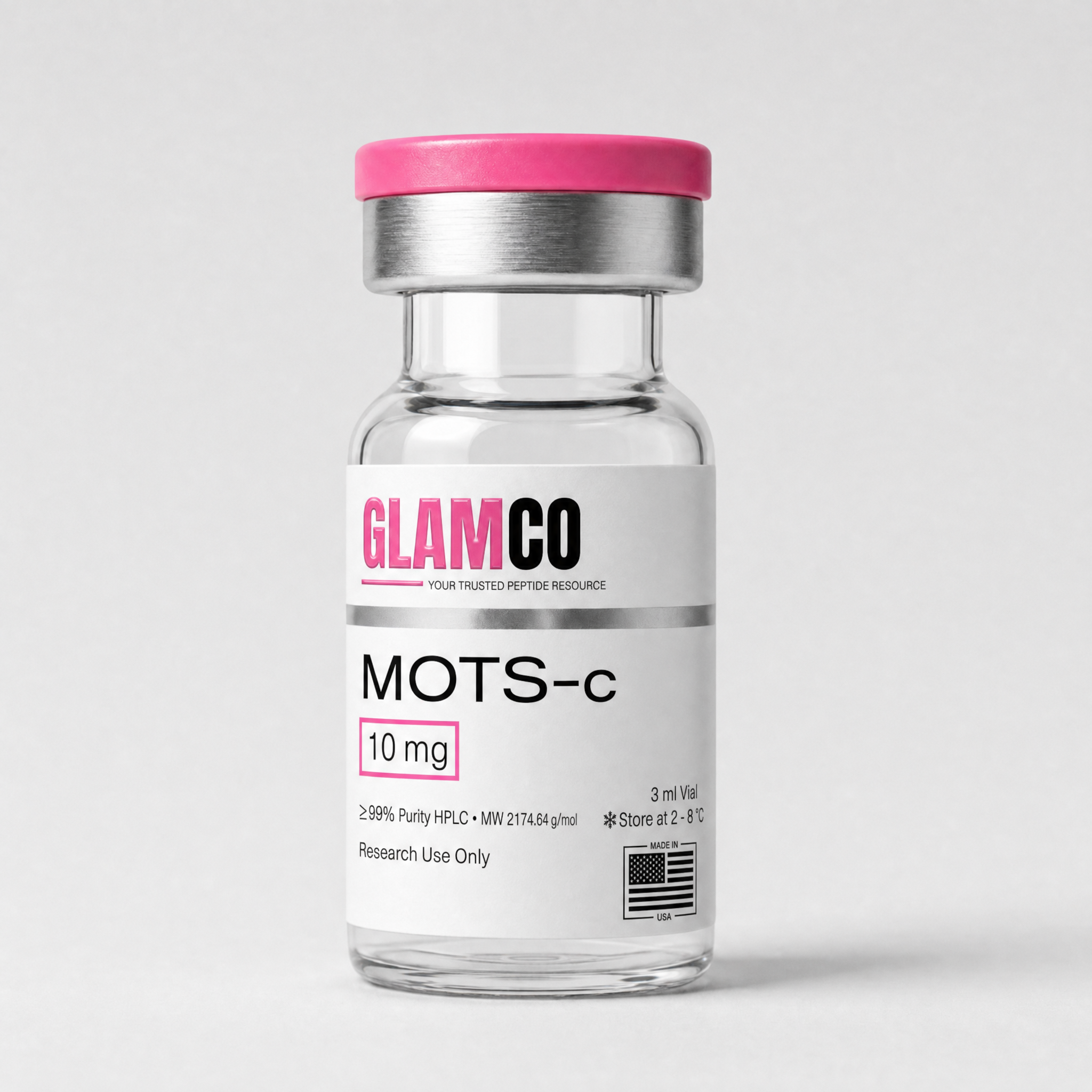
GlamCO MOTS-c
99%+ Purity
Verified by HPLC
Home/Catalog/MOTS-c

MOTS-c

$65.00
Made in USA
cGMP Compliant

Mitochondrial-derived 16-amino-acid peptide (MRWQEMGYIFYPRKLR) encoded within the mtDNA 12S rRNA. Lyophilized peptide for in vitro AMPK and metabolic pathway research only.

TierQuantityDiscount
Most Popular3 - 510%
Max Savings6 +15%
Secure Checkout| Third-Party Tested| Free Shipping $100+
Sterility & EndotoxinsPASSED
Net Content & PurityPASSED
Third-Party Lab Verified

Independently Tested. Verifiably Pure.

Every batch of MOTS-c is sent to an accredited independent laboratory before it ships. Here is exactly what we screen for - and the certificate that proves it.

What We Test Every Batch For

HPLC Purity Analysis
Confirms the peptide is ≥99% pure
Mass Spectrometry
Verifies exact 2174 Da molecular identity
Heavy Metals Screening
Lead, arsenic, cadmium & mercury - Pass
Endotoxins (LPS)
Bacterial endotoxin levels - Pass
Sterility Testing
No microbial contamination - Pass
TFA Content
Residual trifluoroacetic acid - Not Detected
Net Peptide Content
Actual peptide mass per vial verified
🧬
16
Amino Acids
MRWQEMGYIFYPRKLR sequence
2015
Discovered
Lee et al., Cell Metabolism
🔬
12S
rRNA Origin
Encoded within mtDNA
🛡️
99%+
Purity Verified
HPLC tested, COA included
Preclinical Mechanism

How MOTS-c Works

Mitochondrial-derived peptide signaling characterized across AMPK, metabolic, and nuclear translocation research models

AMPK Activation

AMPK Activation Pathway

In the Lee et al. (2015) discovery study, MOTS-c administration in murine and cell models phosphorylates and activates AMP-activated protein kinase (AMPK), the master regulator of cellular energy homeostasis. Activation occurs downstream of altered AMP:ATP ratio and ZMP accumulation.

  • Phosphorylation of AMPKα (Thr172) in skeletal muscle
  • Reduced insulin resistance in diet-induced obese mice
  • Improved glucose disposal in preclinical models
Folate-AICAR Axis

Folate-AICAR Metabolic Axis

Lee et al. demonstrated MOTS-c targets the folate cycle, inhibiting methylenetetrahydrofolate dehydrogenase 2 (MTHFD2) and de novo purine biosynthesis. This causes accumulation of AICAR (ZMP), an endogenous AMPK activator, linking mitochondrial signaling to one-carbon metabolism.

  • Inhibits folate-mediated de novo purine biosynthesis
  • Endogenous AICAR/ZMP accumulation drives AMPK
  • Links mitochondrial peptide to cytosolic metabolism
Stress Translocation

Mitochondrial-Nuclear Stress Signaling

Kim et al. (2018) showed that under metabolic stress (glucose restriction, oxidative stress), MOTS-c translocates from mitochondria to the nucleus where it regulates adaptive nuclear gene expression, including antioxidant response element (ARE) and NFE2L2/Nrf2 target genes.

  • Stress-induced nuclear translocation observed in cell models
  • Regulates nuclear gene expression (ARE/Nrf2 targets)
  • Mitochondrial-to-nucleus retrograde signaling mode
Preclinical Outcomes

What Research Has Shown

Key findings from foundational MOTS-c publications (preclinical and cell models)

AMPK Phosphorylation in Skeletal Muscle (Lee 2015)Significant
Insulin Sensitivity Improvement (HFD mouse model)~40%
Circulating MOTS-c Decline with Age (humans)Decreased
Physical Performance in Aged Mice (Reynolds 2021)Restored
Investigational Fields

Research Applications

Primary areas of MOTS-c preclinical investigation

Mitochondrial Biology

Mitochondrial Biology Research

MOTS-c is a foundational tool for studying mitochondrial-derived peptides (MDPs) and retrograde mitochondrial-to-nucleus signaling. Used to probe how short ORFs within the mitochondrial genome regulate whole-cell physiology.

Lee et al. 2015 ↗
AMPK Pathway

AMPK Pathway Research

Used as a probe for AMPK activation distinct from AICAR or metformin. Engages the folate cycle and ZMP accumulation upstream of AMPKα phosphorylation, providing a mitochondrial-encoded entry point to the AMPK signaling axis.

Lee et al. 2015 ↗
Aging Models

Aging & Sarcopenia Models

Reynolds et al. (2021) reported MOTS-c administration improved physical performance and skeletal muscle function in aged mice. Investigated in preclinical models of age-related metabolic and musculoskeletal decline.

Reynolds et al. 2021 ↗
Metabolic Homeostasis

Metabolic Homeostasis Studies

Cobb et al. (2016) characterized circulating MOTS-c levels and metabolic correlates in human cohorts. Used as a research tool for glucose homeostasis, insulin signaling, and obesity-related metabolic dysfunction in cellular models.

Cobb et al. 2016 ↗
Technical Specifications

Compound Information

Technical specifications and analytical profile

Chemical Name
MOTS-c (Mitochondrial Open Reading Frame of the 12S rRNA-c)
Sequence
MRWQEMGYIFYPRKLR (16 amino acids)
Molecular Weight
~2174 Da
Origin
Encoded within mtDNA 12S rRNA ORF (mitochondrial-derived peptide)
Receptor / Mechanism
No classical cell-surface receptor; intracellular AMPK/folate-cycle signaling
Form
Lyophilized powder
Purity
≥99% (HPLC verified)
Testing
Third-party HPLC, Mass Spec, Endotoxin
Storage (lyophilized)
-20°C for long-term stability
Storage (reconstituted)
2-8°C, use within 14 days
Solubility
Bacteriostatic water for reconstitution
First Described
Lee C. et al., Cell Metabolism 2015 (PMID: 25738459)
COA
Included with every order
Common Inquiries

Frequently Asked Questions

Common questions about MOTS-c research parameters

MOTS-c (Mitochondrial Open Reading Frame of the 12S rRNA-c) is a 16-amino-acid peptide encoded within a small open reading frame inside the mitochondrial 12S ribosomal RNA gene. It was first identified and characterized by Lee et al. in Cell Metabolism (2015) as a mitochondrial-derived peptide (MDP) with bioactivity outside the mitochondrion. Our research-grade MOTS-c is for in vitro research only.
The MOTS-c sequence is MRWQEMGYIFYPRKLR (Met-Arg-Trp-Gln-Glu-Met-Gly-Tyr-Ile-Phe-Tyr-Pro-Arg-Lys-Leu-Arg), 16 amino acids long, with an approximate monoisotopic molecular weight of ~2174 Da. The sequence is encoded within the 12S rRNA region of mitochondrial DNA in a non-canonical open reading frame.
Lee et al. (2015) reported that MOTS-c targets the folate cycle, inhibiting methylenetetrahydrofolate dehydrogenase 2 (MTHFD2) and de novo purine biosynthesis. The resulting accumulation of AICAR (the ribotide ZMP) is an endogenous AMPK activator that phosphorylates AMPKα at Thr172, linking mitochondrial peptide signaling to cytosolic energy sensing.
Yes - Kim et al. (2018, Cell Metabolism) reported that under metabolic stress (glucose restriction, oxidative challenge), MOTS-c translocates from mitochondria to the nucleus, where it regulates adaptive nuclear gene expression including antioxidant response element (ARE) and NFE2L2/Nrf2-dependent stress response genes. This represents a mitochondrial-to-nucleus retrograde signaling mode.
Reynolds et al. (2021, Nature Communications) reported that MOTS-c administration in aged mice improved physical performance and skeletal muscle function in preclinical models of age-related decline. Circulating MOTS-c levels have also been reported to decrease with age in human cohorts (Cobb et al. 2016), positioning MOTS-c as a research probe for mitochondrial-derived aging biology.
Lyophilized MOTS-c should be stored at -20°C for long-term stability. Once reconstituted in bacteriostatic water, it should be refrigerated at 2-8°C and used within 14 days. Avoid repeated freeze-thaw cycles and protect from light. For research use only - not for human consumption.
Academic Literature

Sources & References

Peer-reviewed publications and preclinical studies

PUBMED

The mitochondrial-derived peptide MOTS-c promotes metabolic homeostasis and reduces obesity and insulin resistance

2015 · Lee C et al. · Cell Metabolism · PMID 25738459
View Source ↗
PUBMED

Naturally occurring mitochondrial-derived peptides are age-dependent regulators of apoptosis, insulin sensitivity, and inflammatory markers

2016 · Cobb LJ et al. · Aging · PMID 27613447
View Source ↗
PUBMED

The mitochondrial-encoded peptide MOTS-c translocates to the nucleus to regulate nuclear gene expression in response to metabolic stress

2018 · Kim KH et al. · Cell Metabolism · PMID 29983246
View Source ↗
PUBMED

MOTS-c is an exercise-induced mitochondrial-encoded regulator of age-dependent physical decline and muscle homeostasis

2021 · Reynolds JC et al. · Nature Communications · PMID 33510174
View Source ↗