
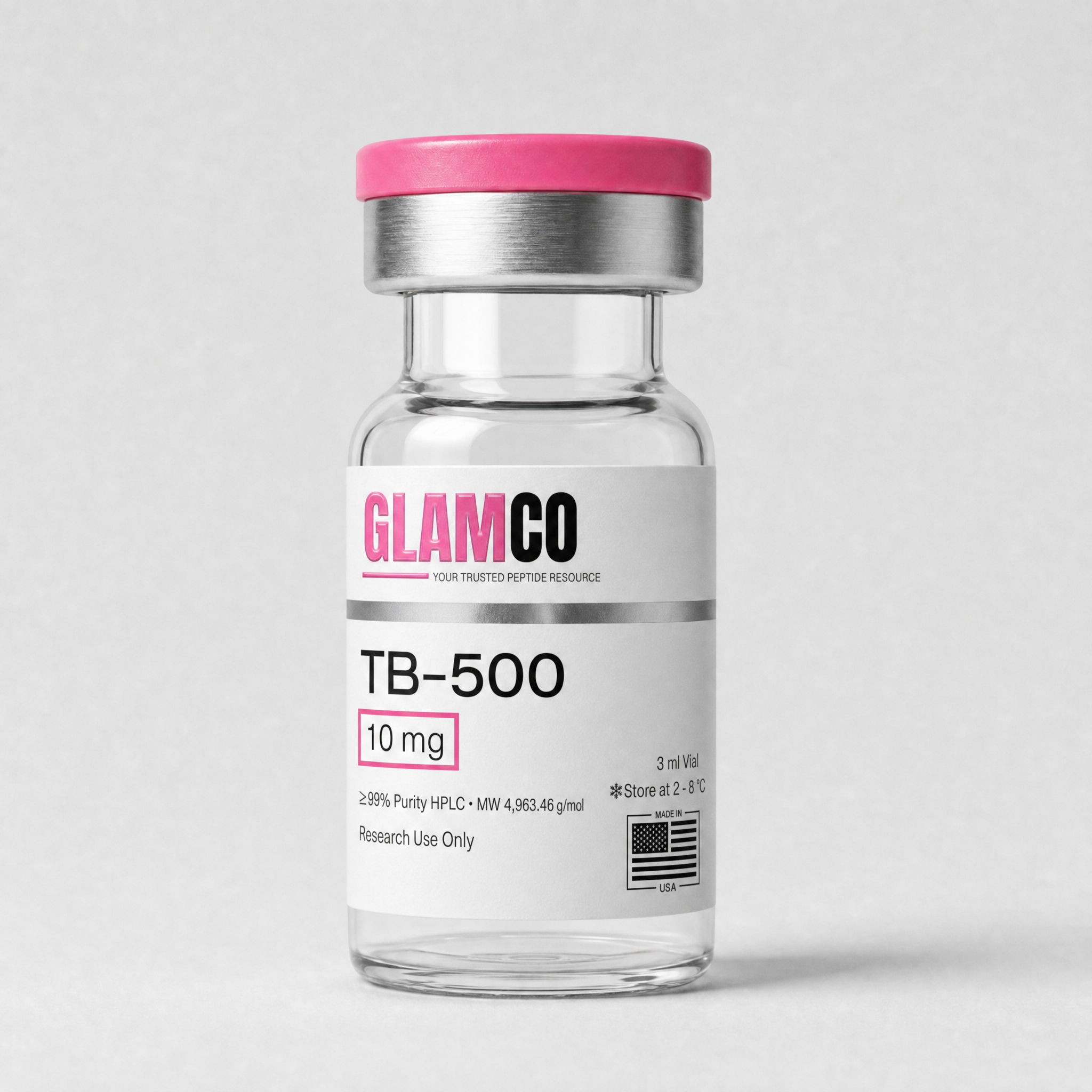
TB-500
Thymosin β4-derived peptide supplied as a lyophilized powder for in vitro tissue regeneration and actin-binding research. Full-length Thymosin β4 (Tβ4) is a 43-amino-acid G-actin-sequestering peptide; "TB-500" is also used in literature for the 7-residue active fragment (LKKTETQ, residues 17–23) — see FAQ for the version supplied.
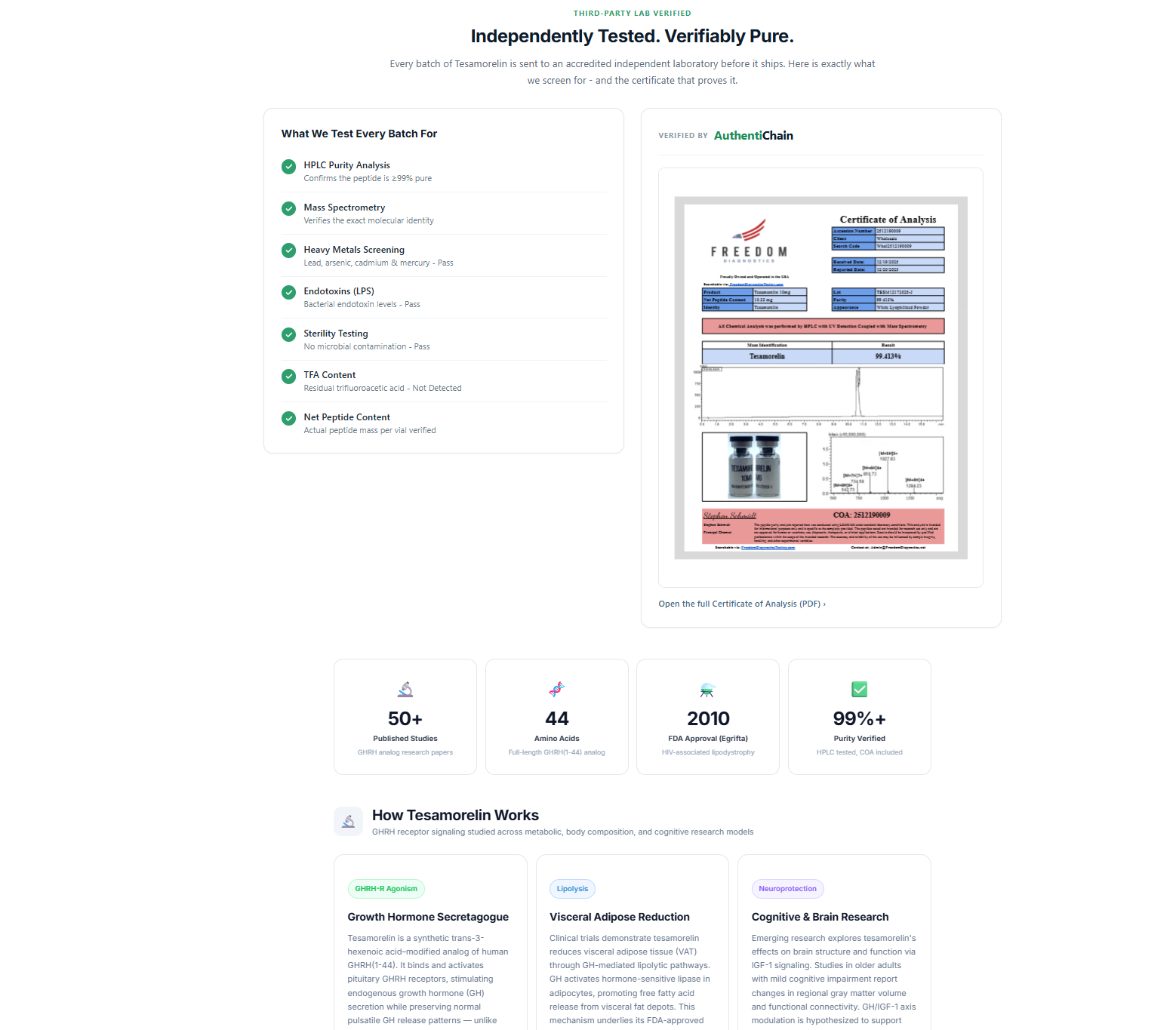
Independently Tested. Verifiably Pure.
Every batch of TB-500 is sent to an accredited independent laboratory before it ships. Here is exactly what we screen for - and the certificate that proves it.
What We Test Every Batch For
How TB-500 Works
Three documented mechanisms from peer-reviewed Thymosin β4 research
G-Actin Sequestration & Cell Migration
Full-length Tβ4 is the principal intracellular G-actin–sequestering peptide in mammalian cells, binding monomeric actin with a Kd of approximately 0.7 µM and buffering 40–50% of the cellular G-actin pool. Controlled release of actin monomers to profilin drives lamellipodial extension and directed cell migration in regenerating tissue (Safer 1991; Goldstein, Hannappel & Kleinman, 2005).
- High-affinity G-actin sequestration (Kd ~0.7 µM)
- Regulates lamellipodia/filopodia formation at the leading edge
- Actin-binding domain maps to residues 17–23 (LKKTETQ)
Tissue Repair & Angiogenic Pathway Research
Tβ4 forms a functional complex with PINCH and integrin-linked kinase (ILK), activating the Akt survival pathway. In murine myocardial infarction models, Tβ4 enhanced cardiomyocyte survival, promoted endothelial migration, and improved cardiac function (Bock-Marquette et al., Nature 2004). Tβ4 also stimulates angiogenesis and accelerates dermal and corneal wound closure (Malinda et al., FASEB J 1999; Philp et al., 2003).
- Activates PINCH/ILK/Akt cell-survival signaling
- Stimulates endothelial cell migration and tube formation
- Accelerated re-epithelialization in dermal & corneal wound models
Anti-Inflammatory & Cytoprotective Research Mechanism
Tβ4 suppresses NF-κB activation and downregulates pro-inflammatory cytokines (TNF-α, IL-1β, IL-6) in injury models, while upregulating laminin-5 and key matrix components. It also scavenges reactive oxygen species and reduces apoptosis in ischemic and chemically injured tissues (Sosne et al. 2010; Crockford et al., Ann NY Acad Sci 2010).
- Inhibits NF-κB nuclear translocation in inflamed cells
- Downregulates TNF-α / IL-1β / IL-6 in injury models
- Reduces ROS and caspase-3–mediated apoptosis
What Research Has Shown
Reported magnitudes of effect from peer-reviewed Tβ4 studies
Research Applications
Primary areas of TB-500 / Thymosin β4 investigation
Tendon & Ligament Recovery Research
Preclinical models report Tβ4 promotes tenocyte and myoblast migration and accelerates structural recovery of injured tendon, ligament, and skeletal muscle via actin-regulated cell motility and laminin/MMP expression.
Philp & Kleinman 2010 ↗Cardiac Repair Preclinical Models
In murine permanent LAD ligation, Tβ4 administration upregulated ILK/Akt activity, enhanced early cardiomyocyte survival, reduced scar volume at day 28, and improved ejection fraction — establishing Tβ4 as a benchmark molecule for cardiac repair research.
Bock-Marquette et al. 2004 ↗Wound & Tissue Regeneration Research
Topical or systemic Tβ4 increased dermal re-epithelialization by up to 61% at day 7 vs saline, with elevated angiogenesis and collagen deposition in full-thickness wound models in rodents.
Malinda et al. 1999 ↗Actin Dynamics Cell Biology
A standard reagent for studying G-actin sequestration, profilin handoff, lamellipodial dynamics, and cytoskeletal remodeling in non-muscle cells. Useful for in vitro motility, scratch-wound, and Boyden-chamber assays.
Goldstein, Hannappel & Kleinman 2005 ↗Compound Information
Technical specifications and analytical profile
Frequently Asked Questions
Common questions about TB-500 research parameters
Sources & References
Peer-reviewed Thymosin β4 publications