
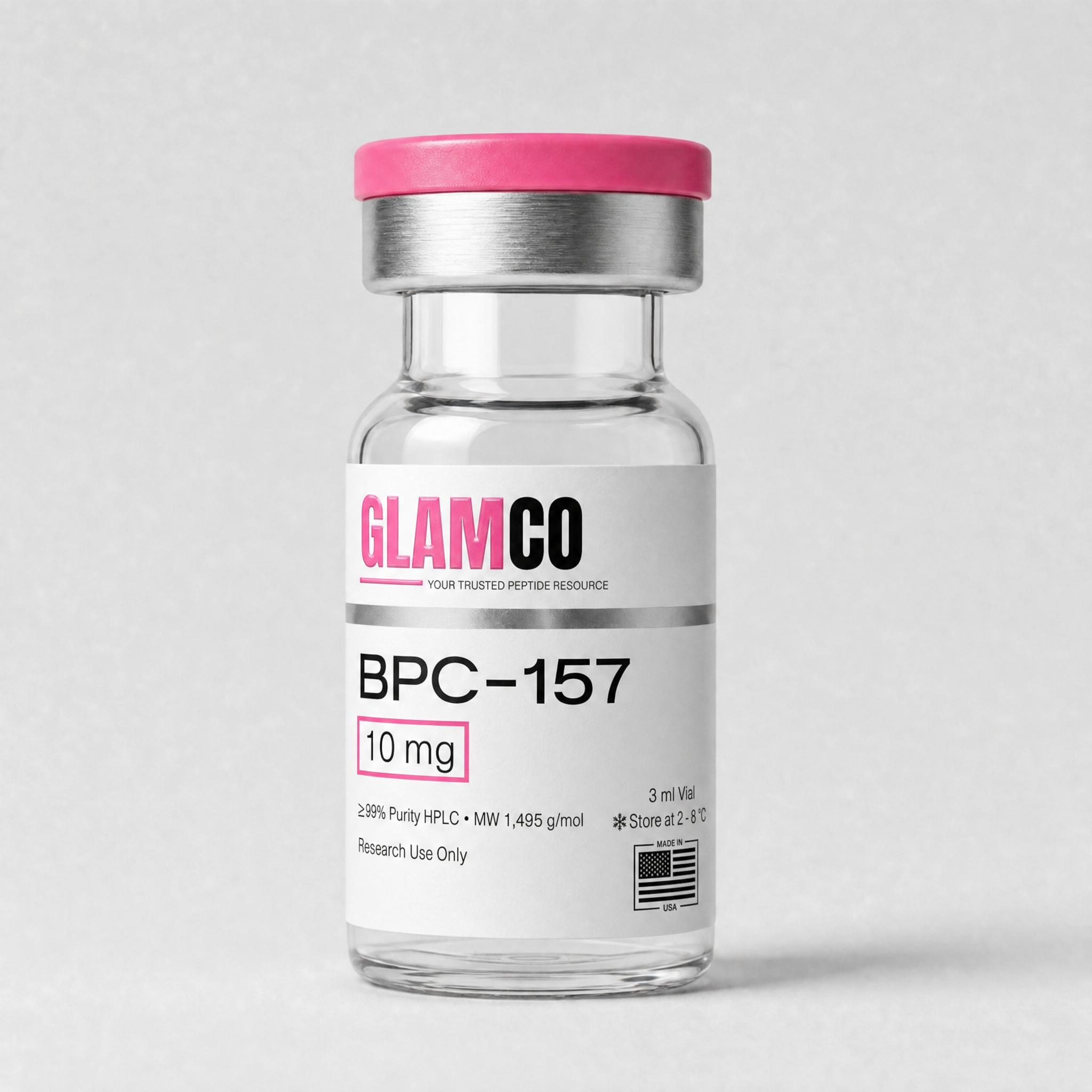
GlamCO BPC-157
99%+ Purity
Verified by HPLC
Home / Catalog / BPC-157

BPC-157

$60.00
Made in USA
cGMP Compliant

BPC-157 is a synthetic 15-amino-acid peptide (GEPPPGKPADDAGLV) representing a partial sequence of "body protection compound" originally identified in gastric juice. Supplied as a lyophilized powder for in vitro and preclinical laboratory research only.

Tier Quantity Discount
Most Popular 3 - 5 10%
Max Savings 6 + 15%
Secure Checkout | Third-Party Tested | Free Shipping $100+
Sterility & Endotoxins PASSED
Net Content & Purity PASSED
Third-Party Lab Verified

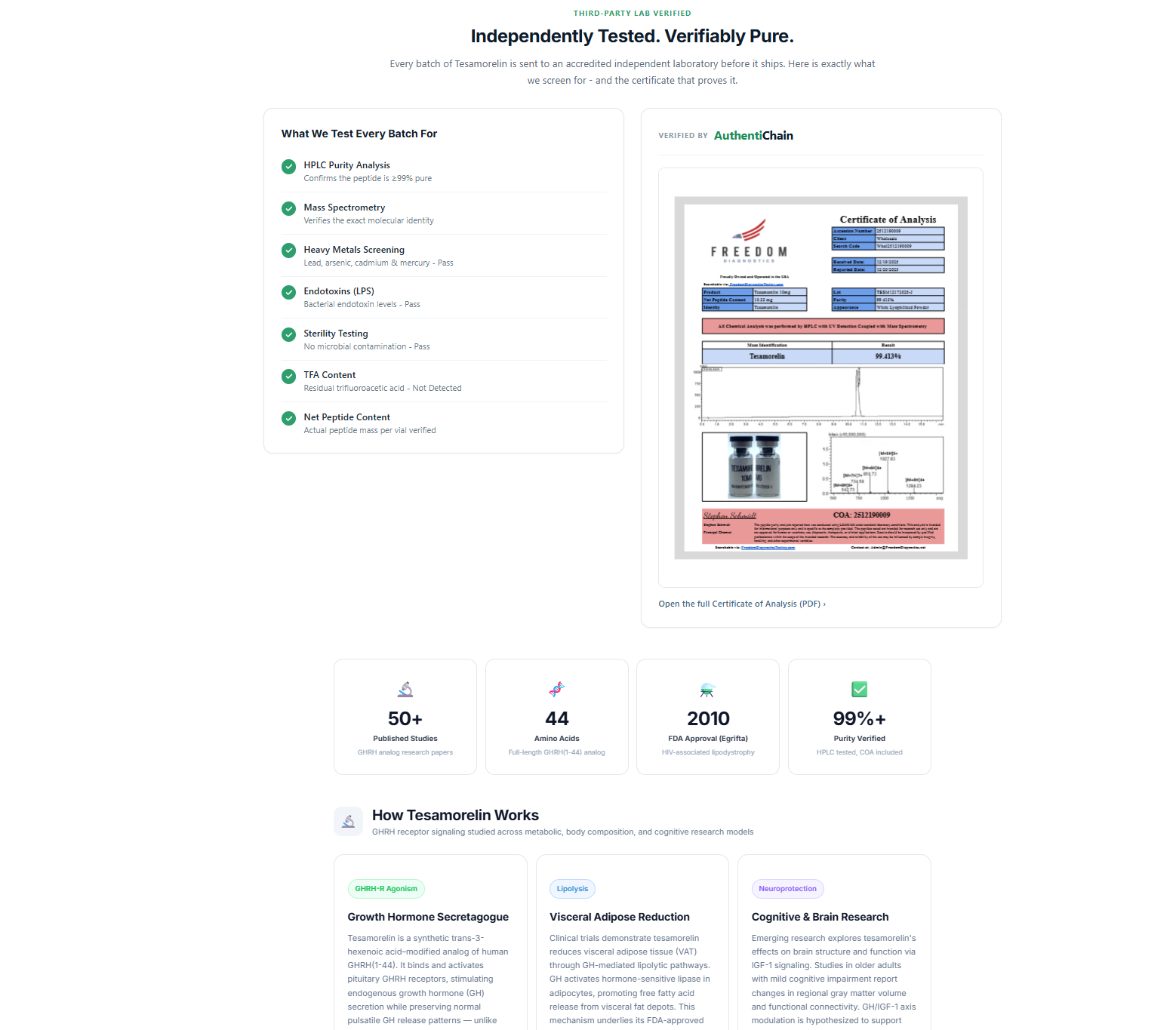
Independently Tested. Verifiably Pure.

Every batch of BPC-157 is sent to an accredited independent laboratory before it ships. Here is exactly what we screen for - and the certificate that proves it.

What We Test Every Batch For
HPLC Purity Analysis
Confirms the peptide is ≥99% pure
Mass Spectrometry
Verifies the exact molecular identity
Heavy Metals Screening
Lead, arsenic, cadmium & mercury - Pass
Endotoxins (LPS)
Bacterial endotoxin levels - Pass
Sterility Testing
No microbial contamination - Pass
TFA Content
Residual trifluoroacetic acid - Not Detected
Net Peptide Content
Actual peptide mass per vial verified
📄
150+
Published Studies
Preclinical BPC-157 research papers
🧬
15
Amino Acids
Partial sequence of body protection compound
🔬
1992
First Described
Sikiric et al., University of Zagreb
🛡️
99%+
Purity Verified
HPLC tested, COA included
Preclinical Mechanism

How BPC-157 Works

Mechanisms described across in vitro and animal model research, including angiogenic signaling, growth-factor modulation, and tendon-ligament fibroblast pathways

Angiogenesis

Angiogenic & Vasculogenic Activity

In CAM, tube-formation, and rodent hindlimb-ischemia models, BPC-157 has been reported to promote angiogenesis associated with VEGFR2 internalization and activation of the VEGFR2-Akt-eNOS pathway, increasing vessel number and accelerating blood-flow recovery (Hsieh et al., 2017).

  • VEGFR2 internalization in endothelial cell culture
  • Activation of Akt-eNOS-NO downstream signaling
  • Increased capillary density in ischemic-tissue models
Cytoprotection

Cytoprotection & Growth-Factor Signaling

Preclinical work describes BPC-157 modulation of growth-factor expression (EGR-1, NAB2) and upregulation of growth-hormone receptor in fibroblasts, alongside maintenance of GI mucosal integrity in injury models via NO-system interactions (Sikiric et al., 2018; Chang et al., 2014).

  • Modulation of EGR-1 / NAB2 early growth response genes
  • Upregulation of growth-hormone receptor expression
  • Interaction with the NO system across animal models
Fibroblast Pathway

Fibroblast & Tendon-Ligament Research Mechanism

In cultured tendon fibroblasts and transected rat Achilles tendon models, BPC-157 accelerated explant outgrowth and dose-dependently increased fibroblast migration via activation of the FAK-paxillin focal-adhesion pathway (Chang et al., 2011).

  • FAK and paxillin phosphorylation in tendon fibroblasts
  • Dose-dependent in vitro fibroblast migration
  • Enhanced explant outgrowth from tendon tissue
Preclinical Outcomes

What Research Has Shown

Key findings reported in peer-reviewed preclinical publications

Tendon Fibroblast Migration (in vitro, dose-dependent) ~2-3×
Achilles Tendon Functional Recovery (rat model) Accelerated
VEGFR2-Driven Vessel Number (ischemic limb model) Increased
GI Mucosal Integrity (rodent injury models) Preserved
Investigational Fields

Research Applications

Primary areas of BPC-157 preclinical investigation

Musculoskeletal

Tendon & Ligament Recovery Research

In transected rat Achilles tendon and medial collateral ligament transection models, BPC-157 reportedly accelerated functional recovery and biomechanical strength, with in vitro work showing dose-dependent fibroblast migration via FAK-paxillin signaling.

Chang et al. 2011 ↗
Gastrointestinal

GI Mucosal Research

As a stable gastric pentadecapeptide, BPC-157 has been investigated across rodent models of gastric ulcer, esophagitis, and inflammatory bowel injury, where it modulated mucosal integrity, NO-system signaling, and reepithelialization markers.

Sikiric et al. 2021 ↗
Neurovascular

Neurovascular Research

In rodent models of stroke and peripheral nerve injury, preclinical studies report BPC-157 effects on neurovascular recovery and vasodilatory NO pathways, consistent with its broader angiogenic and VEGFR2-linked signaling profile.

Hsieh et al. 2017 ↗
Soft Tissue

Muscle / Soft Tissue Healing Research

In rat models of muscle crush injury and disabled myotendinous junctions, BPC-157 was reported to support functional recovery, with associated angiogenic and growth-factor-pathway modulation in injured soft tissue.

Krivic et al. / Sikiric group ↗
Technical Specifications

Compound Information

Technical specifications and analytical profile

Chemical Name
Body Protection Compound 157 (pentadecapeptide; partial sequence of gastric BPC)
Sequence
GEPPPGKPADDAGLV (15 amino acids)
Molecular Formula
C₆₂H₉₈N₁₆O₂₂
Molecular Weight
~1419.5 g/mol
CAS Number
137525-51-0
Form
Lyophilized powder
Purity
≥99% (HPLC verified)
Testing
Third-party HPLC, Mass Spec, Endotoxin
Storage (lyophilized)
2-8°C dry short-term; -20°C for long-term stability
Storage (reconstituted)
2-8°C, use within 14 days; avoid repeated freeze-thaw
Solubility
Water-soluble; bacteriostatic water for reconstitution
Half-life
Reported short plasma t½ (~minutes) in rodent PK; described as "stable" in gastric juice across multiple Sikiric-group publications
COA
Included with every order
Common Inquiries

Frequently Asked Questions

Common questions about BPC-157 research parameters

BPC-157 is a synthetic 15-amino-acid peptide (sequence GEPPPGKPADDAGLV) corresponding to a partial fragment of "body protection compound" (BPC), a larger protein originally identified in human gastric juice. It was first described by Sikiric and colleagues at the University of Zagreb in the early 1990s. BPC-157 is supplied here strictly as a research-grade reference compound for in vitro and preclinical laboratory work, and is not approved by FDA or any other regulator for human use.
Published preclinical literature describes several non-receptor-defined mechanisms. The most cited include: angiogenic activity via VEGFR2 internalization and the VEGFR2-Akt-eNOS pathway (Hsieh et al., 2017); fibroblast migration through FAK-paxillin focal-adhesion signaling in tendon explants (Chang et al., 2011); modulation of early growth-response genes (EGR-1, NAB2) and growth-hormone receptor expression; and interaction with the nitric oxide system across GI and vascular injury models.
Lyophilized BPC-157 should be kept dry at 2-8°C for short-term storage and at -20°C for long-term stability, protected from light and moisture. For laboratory reconstitution, BPC-157 is water-soluble; bacteriostatic water is typically used. Once reconstituted, the solution should be stored at 2-8°C and used within approximately 14 days, avoiding repeated freeze-thaw cycles.
Most published BPC-157 studies are conducted in rodent (rat, mouse) injury models and in primary cell culture. Common in vivo models include transected Achilles tendon, medial collateral ligament transection, gastric ulcer, esophagitis, colitis, muscle crush, and hindlimb ischemia. In vitro work focuses on tendon fibroblast migration assays, endothelial tube-formation assays, and CAM angiogenesis models. The vast majority of published work originates from the Sikiric research group at the University of Zagreb.
The name reflects the origin of the parent molecule: a larger ~40 kDa protein, designated "body protection compound" (BPC), was isolated from human gastric juice in the early 1990s. The 15-amino-acid fragment GEPPPGKPADDAGLV was identified as a stable active portion of that parent protein, hence BPC-157. The "stable gastric pentadecapeptide" language used throughout the Sikiric-group literature refers to its reported stability profile in gastric fluid rather than any clinical claim.
There are over 150 peer-reviewed preclinical publications on BPC-157 in PubMed, predominantly in rodent and cell-culture systems, covering angiogenesis, GI mucosal injury, tendon/ligament healing, neurovascular recovery, and growth-factor signaling. There are no large, completed, peer-reviewed Phase II/III human clinical trials supporting any therapeutic indication, and BPC-157 is not approved by FDA. Material on this page is provided solely for in vitro and preclinical laboratory research and is not intended for human consumption or therapeutic use.
Academic Literature

Sources & References

Peer-reviewed publications and preclinical studies database

PUBMED

Therapeutic potential of pro-angiogenic BPC157 is associated with VEGFR2 activation and up-regulation

2017 · Hsieh MJ et al. · J Mol Med
View Source ↗
PUBMED

The promoting effect of pentadecapeptide BPC 157 on tendon healing: tendon outgrowth, cell survival, cell migration

2011 · Chang CH et al. · J Appl Physiol
View Source ↗
PUBMED

Stable Gastric Pentadecapeptide BPC 157 and Wound Healing

2021 · Sikiric P et al. · Front Pharmacol
View Source ↗
PUBMED

Pentadecapeptide BPC 157 (PL 14736) improves ligament healing in the rat

2010 · Krivic A et al. · J Orthop Res
View Source ↗
PUBMED

Modulatory effect of gastric pentadecapeptide BPC 157 on angiogenesis in muscle and tendon healing

2010 · Sikiric P et al. · Curr Pharm Des
View Source ↗
PUBMED

Stable Gastric Pentadecapeptide BPC 157 as a Therapy for the Disabled Myotendinous Junctions in Rats

2021 · Sikiric group · Biomedicines
View Source ↗