GlamCO NAD+
99%+ Purity
Verified by HPLC
Home / Catalog / NAD+

NAD+

$60.00
Made in USA
cGMP Compliant

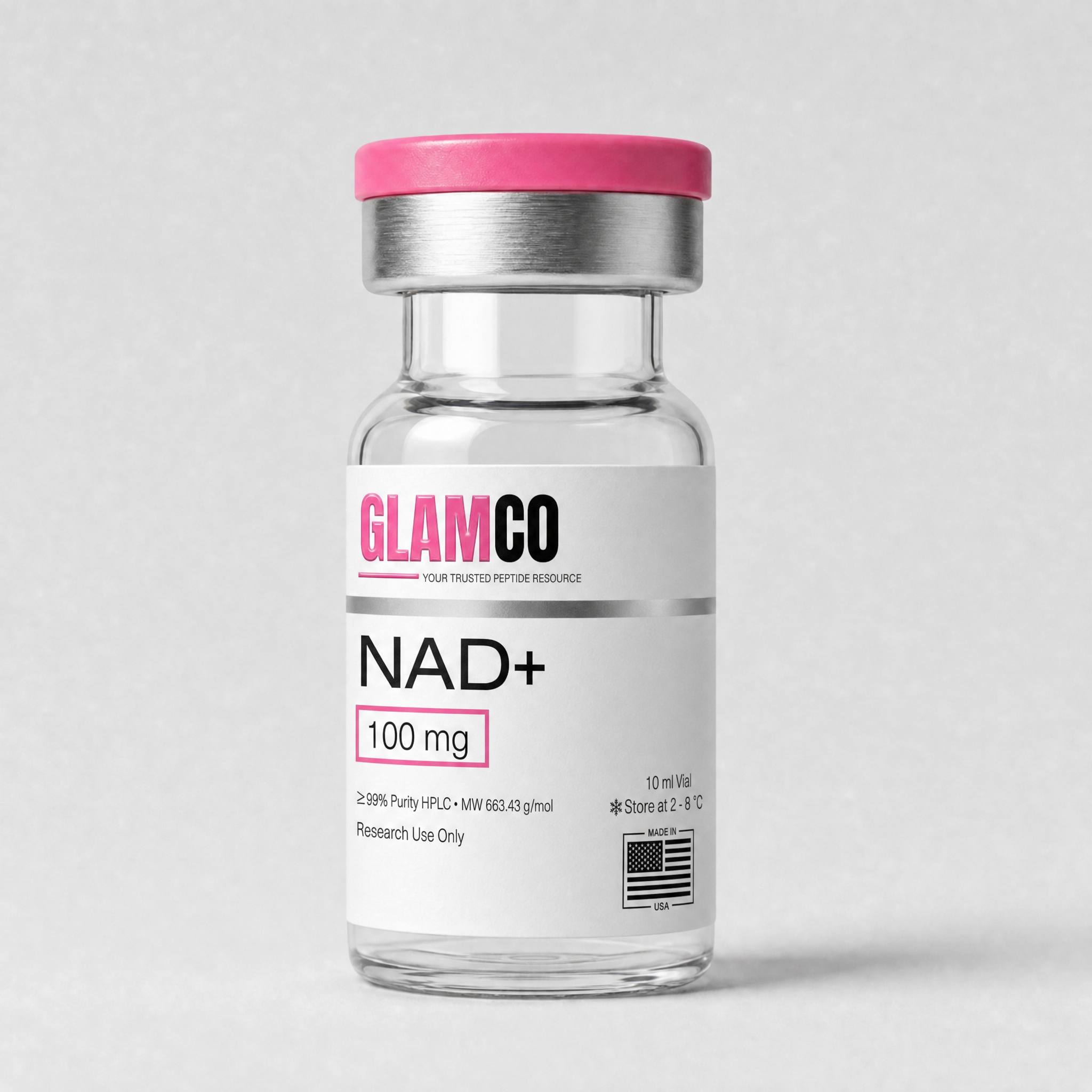
Oxidized dinucleotide cofactor for in vitro redox, sirtuin, and PARP research. Lyophilized NAD+ (nicotinamide adenine dinucleotide) for cellular bioenergetics and longevity model studies.

TierQuantityDiscount
Most Popular3 - 510%
Max Savings6 +15%
Secure Checkout | Third-Party Tested | Free Shipping $100+
Sterility & Endotoxins PASSED
Net Content & Purity PASSED
Third-Party Lab Verified

Independently Tested. Verifiably Pure.

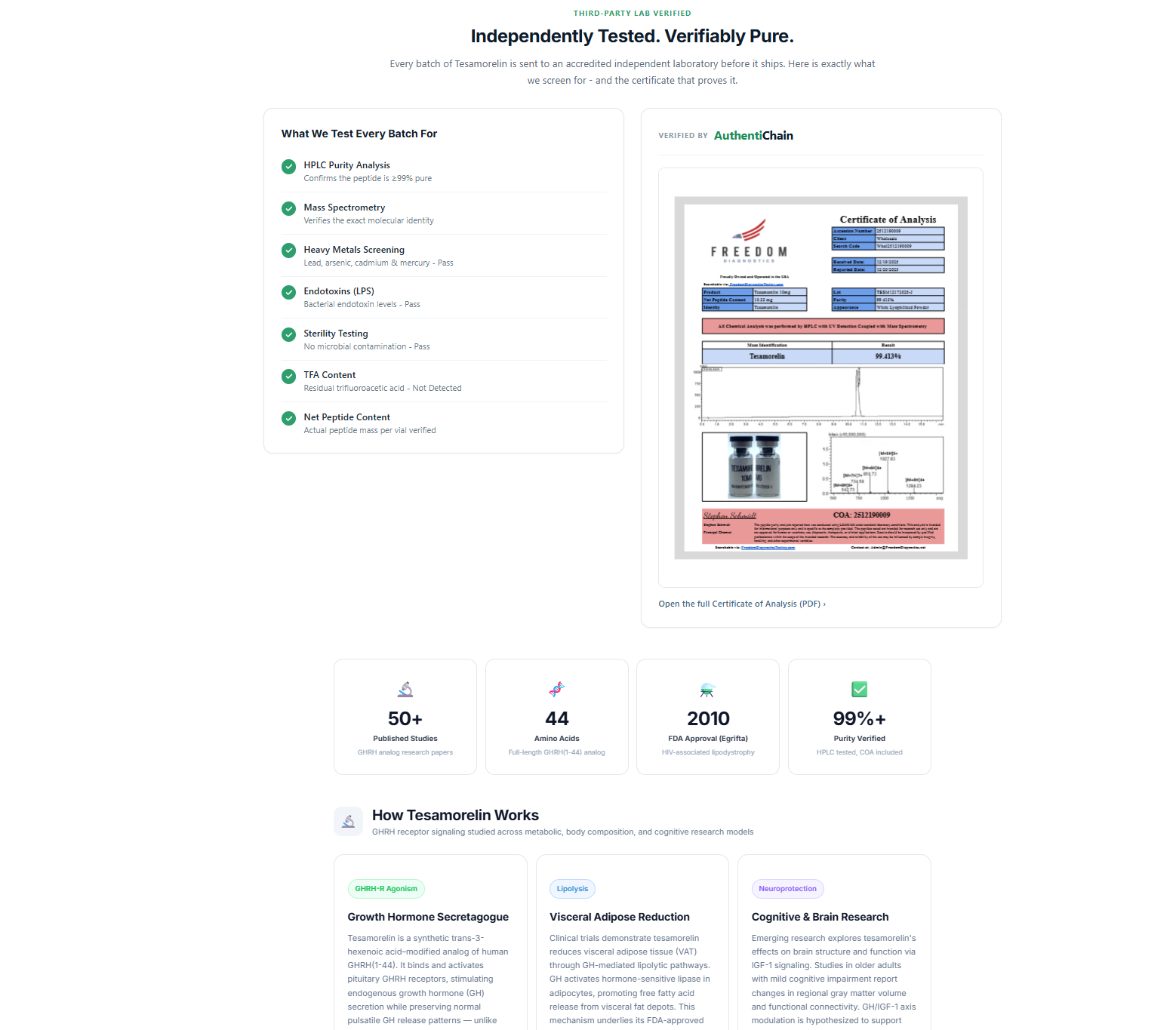
Every batch of NAD+ is sent to an accredited independent laboratory before it ships. Here is exactly what we screen for - and the certificate that proves it.

What We Test Every Batch For
HPLC Purity Analysis
Confirms the dinucleotide is ≥99% pure
Mass Spectrometry
Verifies molecular mass at 663.43 Da
Heavy Metals Screening
Lead, arsenic, cadmium & mercury - Pass
Endotoxins (LPS)
Bacterial endotoxin levels - Pass
Sterility Testing
No microbial contamination - Pass
Residual Solvents
Process solvents - Within ICH Q3C limits
Net Content
Actual NAD+ mass per vial verified
📄
10K+
Published Studies
NAD+ metabolism and sirtuin biology
🧬
663
Molecular Weight (Da)
C21H27N7O14P2 dinucleotide
⚙️
7
Sirtuin Targets
SIRT1-7 NAD+-dependent deacylases
🛡️
99%+
Purity Verified
HPLC tested, COA included
Biochemical Mechanism

How NAD+ Works

Central coenzyme across redox metabolism, sirtuin signaling, and DNA damage response pathways

Redox Coenzyme

Redox Cofactor in Cellular Metabolism

NAD+ cycles between oxidized (NAD+) and reduced (NADH) states across glycolysis, TCA cycle, fatty acid oxidation, and oxidative phosphorylation. It accepts a hydride at the C4 position of the nicotinamide ring, transferring electrons to the mitochondrial electron transport chain.

  • Hydride acceptor at nicotinamide C4 position
  • Drives ETC Complex I (NADH dehydrogenase)
  • Couples catabolic flux to ATP synthesis
Sirtuin Substrate

Sirtuin Substrate (SIRT1-7)

NAD+ is a cleaved cosubstrate for the seven mammalian sirtuins (SIRT1-7), which remove acetyl, succinyl, malonyl, and other acyl modifications from histones and metabolic enzymes. Each catalytic turnover consumes one NAD+ and releases nicotinamide plus O-acetyl-ADP-ribose.

  • Stoichiometric NAD+ consumption per deacylation event
  • Nuclear (SIRT1, 6, 7), mitochondrial (SIRT3-5), cytosolic (SIRT2) targets
  • Couples cellular NAD+ status to gene regulation and metabolism
DNA Damage Response

PARP & CD38 Substrate / DNA Damage Response

PARPs (especially PARP1) use NAD+ as a substrate to synthesize poly(ADP-ribose) chains at DNA strand breaks, recruiting repair machinery. CD38 and SARM1 are additional major NAD+-consuming enzymes whose hydrolase activity strongly modulates intracellular NAD+ pools, particularly in aging and inflammation models.

  • PARP1 PARylation of histones and repair factors at DNA breaks
  • CD38 hydrolyzes NAD+ to nicotinamide + ADP-ribose
  • NAMPT salvage pathway recycles nicotinamide back to NAD+
Preclinical Outcomes

What Research Has Shown

Reported findings across NAD+ biology and aging research models

NAD+ Decline in Aged Tissue (preclinical models) ~50%
Hepatic NAD+ Restoration via Precursors (Yoshino et al.) ~2x
SIRT1 Activity Recovery in Aged Cells Restored
CD38 Knockout NAD+ Elevation (Camacho-Pereira et al.) Elevated
Investigational Fields

Research Applications

Primary areas of NAD+ investigation

Aging Biology

Aging & Senescence Research

NAD+ levels decline in multiple tissues across mammalian aging. Models examine NAD+ pool dynamics, precursor (NMN, NR) supplementation, CD38 upregulation, and links to senescence-associated secretory phenotype (SASP). Reviewed by Covarrubias et al. 2021.

Covarrubias et al. 2021 ↗
Epigenetics

Sirtuin / Epigenetic Regulation

Used as cofactor in biochemical and cell-based assays of SIRT1-7 activity on histone (H3K9ac, H3K14ac) and non-histone substrates. Imai & Guarente articulated the NAD+-sirtuin axis as central to metabolic and aging regulation.

Imai & Guarente 2014 ↗
Bioenergetics

Mitochondrial Bioenergetics

NAD+/NADH ratio governs mitochondrial respiration, ETC Complex I flux, and TCA cycle activity. Used to interrogate mitochondrial dysfunction models, SIRT3 deacetylation of metabolic enzymes, and metabolic adaptation in disease models. See Verdin 2015 in Science.

Verdin 2015 ↗
Genome Stability

DNA Damage Response Research

Substrate for PARP1/PARP2 in poly(ADP-ribosyl)ation at DNA single- and double-strand breaks. Used in studies of base excision repair, replication stress, and the PARP-NAD+-SIRT1 crosstalk relevant to genome maintenance. See Rajman et al. 2018.

Rajman et al. 2018 ↗
Technical Specifications

Compound Information

Technical specifications and analytical profile

Chemical Name
Nicotinamide Adenine Dinucleotide (oxidized)
Structure
Nicotinamide mononucleotide (NMN) + AMP linked via pyrophosphate
Molecular Formula
C₂₁H₂₇N₇O₁₄P₂
Molecular Weight
663.43 Da
CAS Number
53-84-9
Form
Lyophilized powder
Purity
≥99% (HPLC verified)
Testing
Third-party HPLC, Mass Spec, Endotoxin
Storage
2-8°C, dry, light-protected (long-term: -20°C)
Reconstitution
Bacteriostatic or sterile water; protect from light
COA
Included with every order
Common Inquiries

Frequently Asked Questions

Common questions about NAD+ research parameters

NAD+ is the oxidized form of nicotinamide adenine dinucleotide (C₂₁H₂₇N₇O₁₄P₂, 663.43 Da), composed of nicotinamide mononucleotide (NMN) linked to AMP via a pyrophosphate bond. NADH is its two-electron reduced form. NMN and NR (nicotinamide riboside) are upstream precursors in the salvage pathway, converted to NAD+ via NMNAT enzymes.
Tissue NAD+ levels decline with chronological age in multiple mammalian models, partly through increased CD38 activity and reduced NAMPT expression. This decline is implicated in mitochondrial dysfunction, sirtuin underactivity, and impaired DNA repair, making NAD+ a central node in aging biology research (Verdin 2015; Rajman et al. 2018).
Three major classes consume NAD+ non-redox: (1) sirtuins (SIRT1-7), which cleave NAD+ during protein deacylation; (2) PARPs (especially PARP1), which build poly(ADP-ribose) at DNA damage sites; and (3) NAD+ glycohydrolases including CD38, CD157, and SARM1, which hydrolyze NAD+ to nicotinamide and ADP-ribose.
In vitro research applications include serving as a cosubstrate in biochemical sirtuin and PARP activity assays, as a redox cofactor in enzyme-coupled assays (LDH, ADH, GAPDH), in cellular bioenergetics measurements, and as a standard for NAD+/NADH ratio quantification by HPLC or cycling assays. For research use only.
Lyophilized NAD+ should be stored dry, light-protected at 2-8°C for routine use and at -20°C for long-term stability. Reconstitute in sterile or bacteriostatic water; NAD+ is most stable around neutral pH and degrades in alkaline conditions. Avoid repeated freeze-thaw cycles of reconstituted stock.
No. GlamCO NAD+ is supplied strictly for in vitro research and laboratory use only. It is not a drug, dietary supplement, or food product, and is not intended for human or veterinary consumption, diagnosis, or therapy.
Academic Literature

Sources & References

Peer-reviewed publications from PubMed
PUBMED

NAD+ in Aging, Metabolism, and Neurodegeneration

2015 · Verdin E · Science
View Source ↗
PUBMED

NAD+ and Sirtuins in Aging and Disease

2014 · Imai S, Guarente L · Trends Cell Biol
View Source ↗
PUBMED

Therapeutic Potential of NAD-Boosting Molecules

2018 · Rajman L, Chwalek K, Sinclair DA · Cell Metab
View Source ↗
PUBMED

NAD+ Metabolism and Its Roles in Cellular Processes During Ageing

2021 · Covarrubias AJ et al. · Nat Rev Mol Cell Biol
View Source ↗