
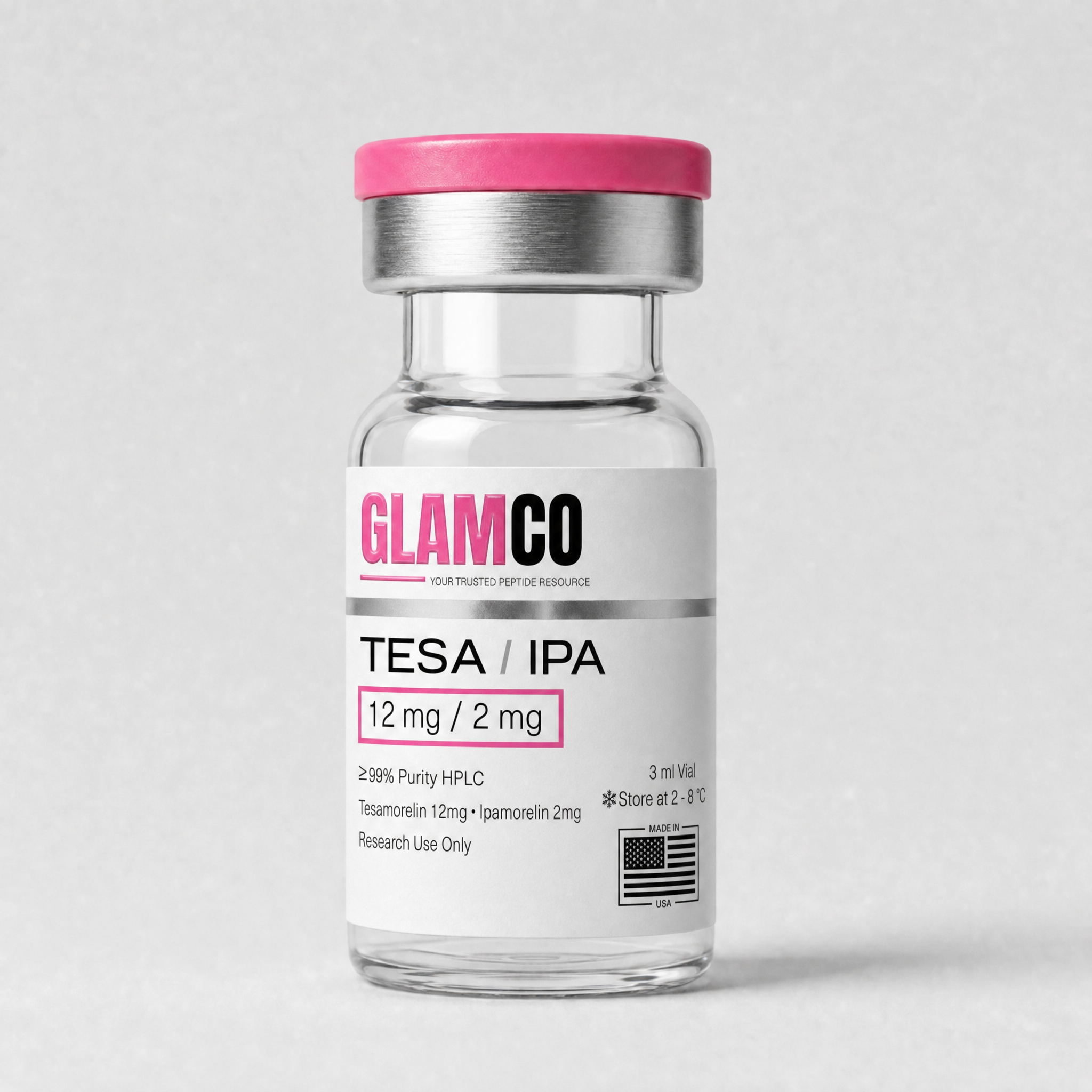
GlamCO TESA / IPA Blend
99%+ Purity
Verified by HPLC
Home / Catalog / TESA / IPA Blend

TESA / IPA Blend

$135.00
Made in USA
cGMP Compliant

Co-lyophilized research blend pairing tesamorelin (GHRH analog) with ipamorelin (selective GHS-R1a agonist) for in vitro investigation of the GH/IGF-1 axis under dual GHRH-R + GHS-R stimulation.

Tier Quantity Discount
Most Popular 3 - 5 10%
Max Savings 6 + 15%
Secure Checkout | Third-Party Tested | Free Shipping $100+
Sterility & Endotoxins PASSED
Net Content & Purity PASSED
Third-Party Lab Verified

Independently Tested. Verifiably Pure.

Every batch of TESA / IPA Blend is sent to an accredited independent laboratory before it ships. Here is exactly what we screen for - and the certificate that proves it.

What We Test Every Batch For
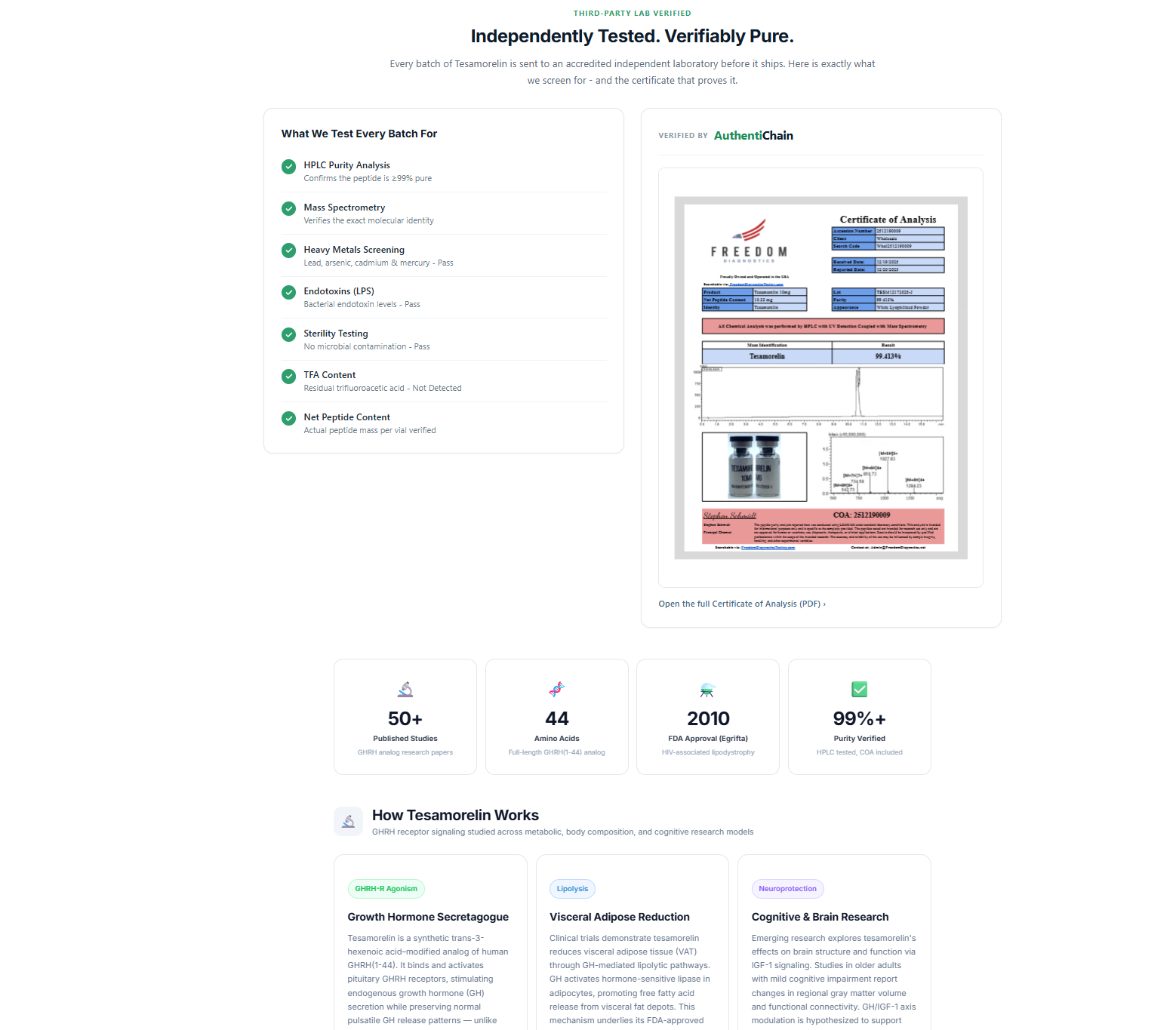
HPLC Purity Analysis
Confirms each peptide is ≥99% pure
Mass Spectrometry
Verifies molecular identity of both peptides
Heavy Metals Screening
Lead, arsenic, cadmium & mercury - Pass
Endotoxins (LPS)
Bacterial endotoxin levels - Pass
Sterility Testing
No microbial contamination - Pass
TFA Content
Residual trifluoroacetic acid - Not Detected
Net Peptide Content
Mass of each peptide per vial verified
🧬
2
Receptor Targets
GHRH-R + GHS-R1a synergy
📈
5x
Synergistic GH Release
GHRH + GHRP combination (Bowers 2004)
2010
Tesamorelin FDA Date
Egrifta (HIV lipodystrophy)
🛡️
99%+
Purity Verified
HPLC tested, COA included
Dual-Pathway Mechanism

How TESA / IPA Blend Works

Complementary GHRH-receptor and ghrelin-receptor signaling drive amplified, pulsatile GH release in preclinical models

Tesamorelin GHRH-R Agonism

GHRH-Receptor Agonism

Tesamorelin is a synthetic trans-3-hexenoyl-modified analog of human GHRH(1-44). The N-terminal lipidation confers DPP-IV resistance, extending half-life relative to native GHRH while preserving full agonism at the pituitary GHRH receptor.

  • Binds pituitary GHRH-R (somatotrophs)
  • Resists DPP-IV cleavage (~26 min half-life)
  • Stimulates GH transcription via cAMP/PKA
Ipamorelin GHS-R1a Selective Activation

GHS-R1a Selective Activation

Ipamorelin (Aib-His-D-2-Nal-D-Phe-Lys-NH₂) is a pentapeptide ghrelin-mimetic GHRP. Raun et al. (1998) characterized it as one of the most selective GHS-R1a agonists, releasing GH without measurable elevation of ACTH, cortisol, or prolactin in preclinical models.

  • Selective GHS-R1a (ghrelin receptor) agonism
  • Activates PLC/IP3/Ca²⁺ in somatotrophs
  • Suppresses somatostatin tone
Synergistic GH/IGF-1 Axis Stimulation

Synergistic GH/IGF-1 Axis Stimulation

Bowers and colleagues demonstrated that combined GHRH + GHRP administration produces GH responses substantially greater than additive, via complementary intracellular signaling (cAMP from GHRH-R, Ca²⁺ from GHS-R1a) and concurrent somatostatin tone reduction.

  • cAMP + Ca²⁺ pathway co-activation
  • Greater-than-additive GH peak amplitude
  • Sustained downstream hepatic IGF-1 output
Preclinical Outcomes

What Research Has Shown

Key findings from GHRH + GHRP combination studies and constituent peptide trials

GH Peak vs. GHRH-Alone (Bowers et al. 2004) ~5x
IGF-1 Elevation (Tesamorelin, Falutz 2007) ~100%
Ipamorelin Selectivity (vs. ACTH/cortisol) No rise
Pulsatile GH Profile Preserved Maintained
Investigational Fields

Research Applications

Primary areas of GHRH-analog + GHRP combination investigation

Endocrinology

GH/IGF-1 Axis Research

Dual GHRH-R + GHS-R1a stimulation provides a model for studying maximal somatotroph capacity, downstream IGF-1 generation, and feedback regulation in preclinical systems.

Bowers et al. 2004 ↗
Pharmacology

Pituitary Secretagogue Studies

Ipamorelin's high selectivity for GHS-R1a — releasing GH without ACTH, cortisol, or prolactin elevation — makes the blend a cleaner research probe than non-selective GHRPs like GHRP-6.

Raun et al. 1998 ↗
Metabolic

Body Composition Preclinical

Tesamorelin reduces visceral adipose tissue ~15% over 26 weeks via GH-mediated lipolysis; combination models examine whether GHRP co-administration alters lean-mass and lipolytic response.

Falutz et al. 2007 ↗
Neuroendocrine

GH-Pulsatility Research

Combined GHRH-analog + GHRP regimens preserve physiological GH pulsatility while amplifying peak amplitude — relevant for studying sleep-related GH bursts and somatostatin tone in aging models.

Veldhuis & Bowers 2010 ↗
Technical Specifications

Compound Information

Co-lyophilized blend: tesamorelin (GHRH analog) + ipamorelin (GHRP)

Blend Format
Co-lyophilized two-peptide blend
Peptide 1 — Name
Tesamorelin (GHRH analog)
Tesamorelin — Sequence
trans-3-hexenoyl-Tyr-Ala-Asp-Ala-Ile-Phe-Thr-...-Leu-NH₂ (44 aa, modified GHRH(1-44))
Tesamorelin — Molecular Weight
~5196 Da
Peptide 2 — Name
Ipamorelin (GHRP, GHS-R1a agonist)
Ipamorelin — Sequence
Aib-His-D-2-Nal-D-Phe-Lys-NH₂ (pentapeptide)
Ipamorelin — Molecular Weight
711.85 Da
Form
Lyophilized powder (single vial, dual peptide)
Purity
≥99% each (HPLC verified)
Testing
Third-party HPLC, Mass Spec, Endotoxin
Storage (lyophilized)
-20°C for long-term stability
Storage (reconstituted)
2-8°C, use within 14 days
Reconstitution
Bacteriostatic water for reconstitution
COA
Included with every order
Common Inquiries

Frequently Asked Questions

Common questions about the TESA / IPA Blend research parameters

The two peptides activate different receptor systems with complementary intracellular signaling. Tesamorelin agonizes the GHRH receptor (cAMP/PKA pathway), while ipamorelin activates GHS-R1a (PLC/IP3/Ca²⁺ pathway) and reduces somatostatin tone. Co-administration in preclinical models produces a greater-than-additive GH peak — useful for studying maximal somatotroph capacity in a single in vitro system.
Both pair a GHRH-class peptide with ipamorelin. CJC-1295 (DAC) is a tetrasubstituted GHRH(1-29) analog with a maleimide linker for albumin binding, giving it a multi-day half-life and a flat GH-axis "bleed." Tesamorelin is the full-length GHRH(1-44) with trans-3-hexenoyl modification — shorter half-life (~26 min) but better-defined Phase III clinical data on visceral adipose reduction. Researchers tend to choose CJC/IPA for sustained baseline elevation studies and TESA/IPA when modeling discrete pulsatile peaks aligned with full-length GHRH pharmacology.
In Raun et al. (1998), ipamorelin released GH in pigs and rats with a potency similar to GHRP-6 but without the concurrent ACTH, cortisol, or prolactin elevations characteristic of older GHRPs. This selectivity profile makes it preferable for research models attempting to isolate GHS-R1a-mediated effects from confounding HPA-axis activation.
Tesamorelin is a synthetic GHRH(1-44) analog with N-terminal trans-3-hexenoyl modification that protects against DPP-IV cleavage. Phase III data (Falutz et al. 2007, NEJM) demonstrated ~15-18% reduction in visceral adipose tissue and a near-doubling of IGF-1 in HIV-associated lipodystrophy at 26 weeks. FDA-approved as Egrifta in 2010.
Store the lyophilized vial at -20°C for long-term stability. Reconstitute with bacteriostatic water for research use; once reconstituted, refrigerate at 2-8°C and use within 14 days. Both peptides are sensitive to repeated freeze-thaw cycles and light. For in vitro research use only.
Tesamorelin holds FDA approval (Egrifta, 2010) for HIV-associated lipodystrophy. Ipamorelin was developed by Novo Nordisk and remained investigational — no marketing authorization was granted in the EU or US. This product is research-grade material supplied for in vitro use only.
Academic Literature

Sources & References

Peer-reviewed publications on tesamorelin, ipamorelin, and GHRH/GHRP combination pharmacology
PUBMED

Metabolic effects of a growth hormone-releasing factor in patients with HIV (NEJM)

2007 · Falutz J et al. · NEJM 357:2359
View Source ↗
PUBMED

Ipamorelin, the first selective growth hormone secretagogue

1998 · Raun K et al. · Eur J Endocrinol 139:552
View Source ↗
PUBMED

GH-releasing peptide and hormone synergistic mechanisms

2004 · Bowers CY · Endocrine 25:9
View Source ↗
PUBMED

Aging and the GHRH/GHRP secretagogue system review

2010 · Veldhuis JD & Bowers CY · Endocrine 38:13
View Source ↗