
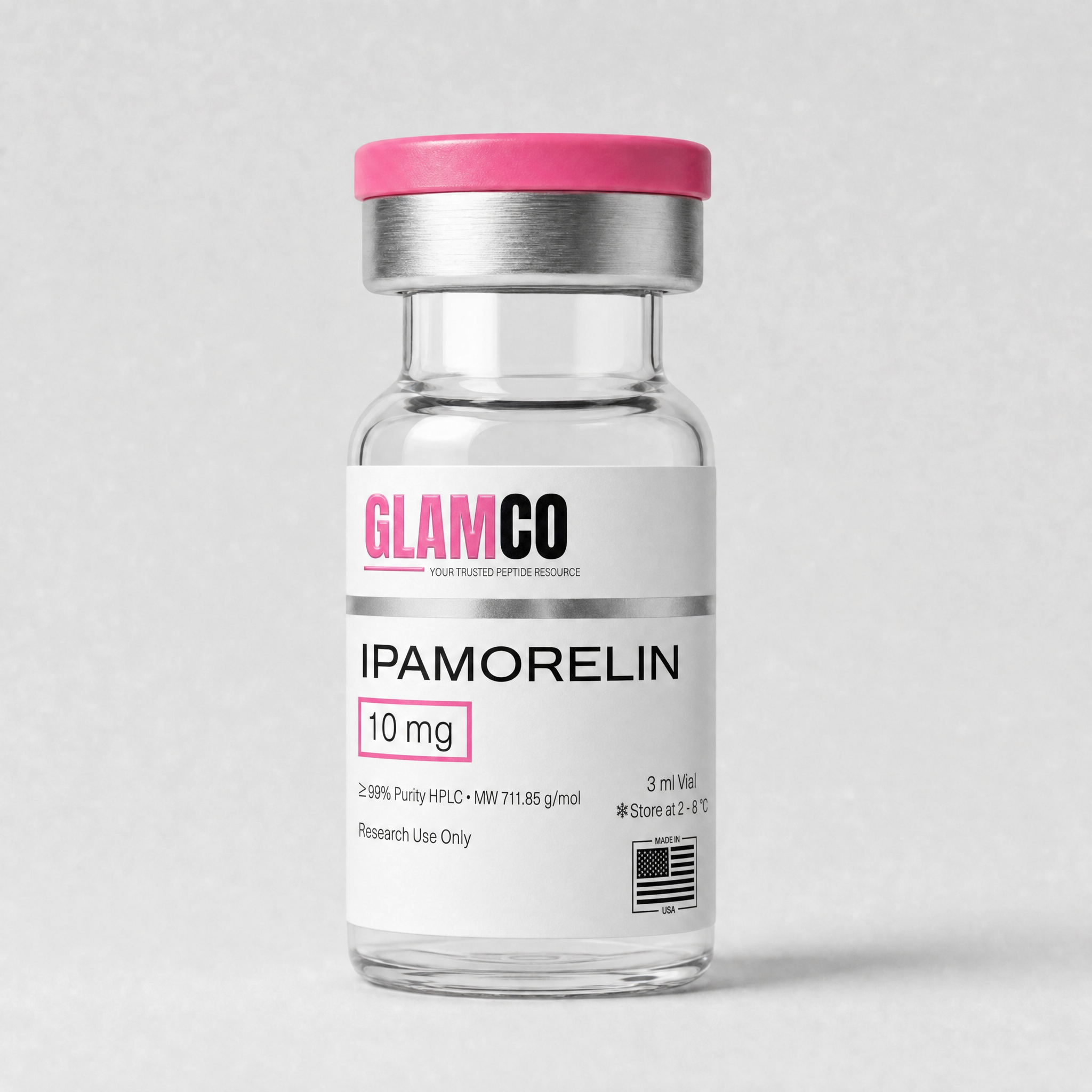
GlamCO Ipamorelin pentapeptide research vial
99%+ Purity
Verified by HPLC
Home / Catalog / Ipamorelin

Ipamorelin

$80.00
Made in USA
cGMP Compliant

Ipamorelin is a selective pentapeptide GHS-R1a agonist for in vitro investigation of the ghrelin/GH-secretagogue axis. Characterized in preclinical literature as a clean GH-releasing tool with minimal cortisol, prolactin, or ACTH cross-activation.

Tier Quantity Discount
Most Popular 3 - 5 10%
Max Savings 6 + 15%
Secure Checkout | Third-Party Tested | Free Shipping $100+
Sterility & Endotoxins PASSED
Net Content & Purity PASSED
Third-Party Lab Verified

Independently Tested. Verifiably Pure.

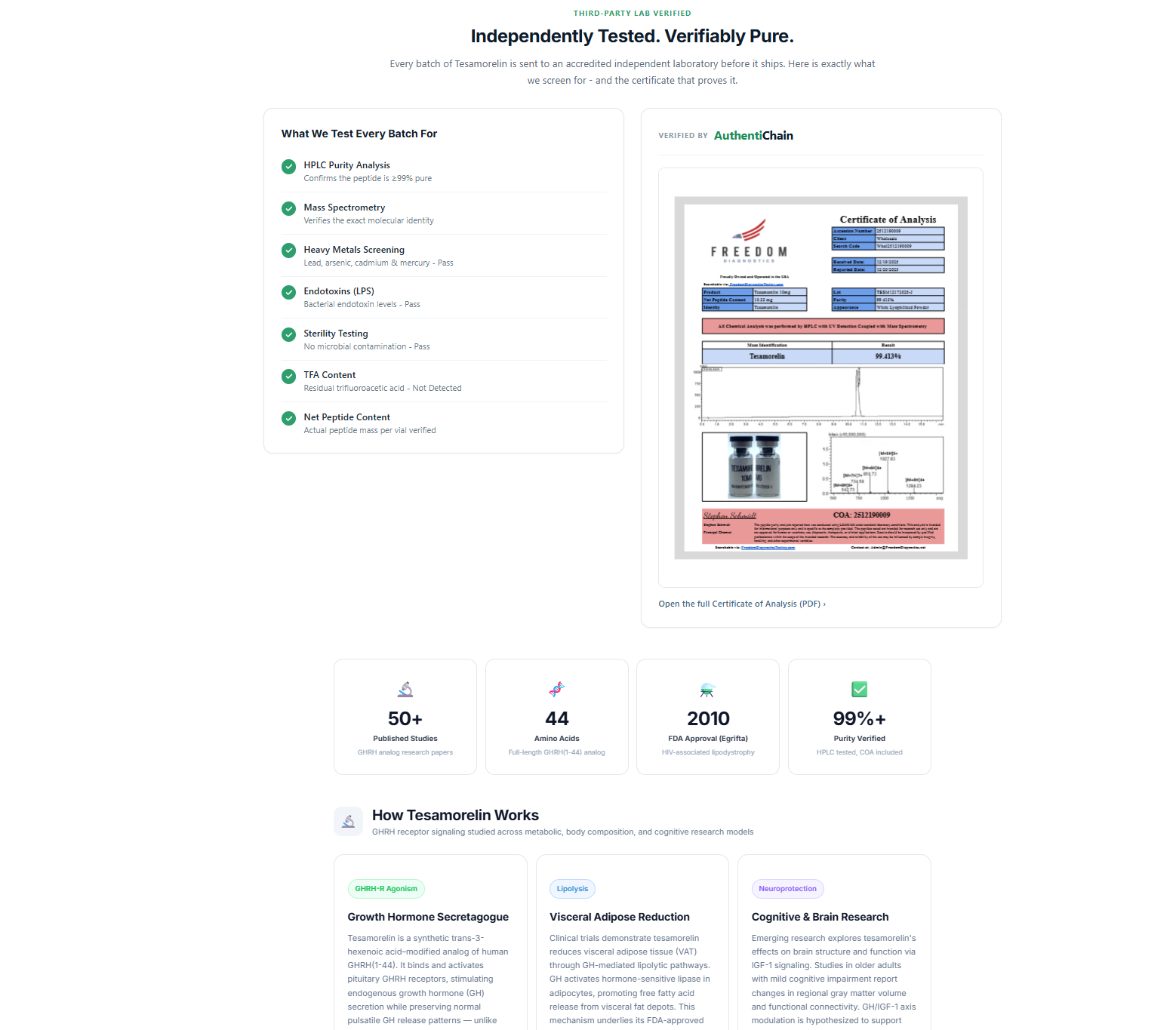
Every batch of Ipamorelin is sent to an accredited independent laboratory before it ships. Here is exactly what we screen for - and the certificate that proves it.

What We Test Every Batch For
HPLC Purity Analysis
Confirms the peptide is ≥99% pure
Mass Spectrometry
Verifies the exact molecular identity (~711.85 Da)
Heavy Metals Screening
Lead, arsenic, cadmium & mercury - Pass
Endotoxins (LPS)
Bacterial endotoxin levels - Pass
Sterility Testing
No microbial contamination - Pass
TFA Content
Residual trifluoroacetic acid - Not Detected
Net Peptide Content
Actual peptide mass per vial verified
🧬
5
Amino Acid Residues
Aib-His-D-2-Nal-D-Phe-Lys-NH₂
⚖️
~712
Molecular Weight (Da)
Pentapeptide ghrelin mimetic
📝
1998
First Characterization
Raun et al., Eur J Endocrinol
🛡️
99%+
Purity Verified
HPLC tested, COA included
Preclinical Mechanism

How Ipamorelin Works

Selective GHS-R1a signaling characterized across in vitro and animal-model GH-axis research

GHS-R1a Agonism

Selective GHS-R1a Agonism

Ipamorelin is a synthetic pentapeptide (Aib-His-D-2-Nal-D-Phe-Lys-NH₂) that binds the growth hormone secretagogue receptor 1a (GHS-R1a), the same receptor activated by endogenous ghrelin. The Aib (aminoisobutyric acid) residue and D-amino-acid backbone confer protease resistance and receptor selectivity in binding assays.

  • Pentapeptide ghrelin-mimetic backbone
  • High-affinity binding at GHS-R1a in receptor assays
  • Aib residue stabilizes the active conformation
Clean GH Release

GH Release Without Cortisol/Prolactin Elevation

Raun et al. (1998) and subsequent comparative studies characterized ipamorelin as the first GHRP capable of stimulating pituitary GH release in animal models without significantly elevating cortisol, ACTH, or prolactin — distinguishing it from earlier GHRPs such as GHRP-6 and hexarelin.

  • Robust GH release in rat & swine preclinical models
  • No measurable cortisol or ACTH elevation at GH-active doses
  • No significant prolactin spike vs. GHRP-6 controls
Pulsatile GH Pathways

Pulsatile GH Pathways in Preclinical Models

GHS-R1a agonism preserves the hypothalamic-pituitary feedback loop, allowing GH release to remain pulsatile rather than tonic. Ipamorelin is widely used in research as a probe for studying somatostatin opposition, ghrelin-axis pharmacology, and synergy with GHRH analogs.

  • Preserves pulsatile GH secretion architecture
  • Synergistic GH response when paired with GHRH analogs
  • Standard reference compound in GHS-R comparative work
Preclinical Outcomes

What Research Has Shown

Key findings from in vitro receptor assays and animal-model GH-axis publications

GH Release Magnitude vs. Vehicle (Raun 1998, swine) ~15×
GHS-R1a Selectivity (vs. other GHRPs in binding assays) High
Cortisol / ACTH Cross-Activation Negligible
Prolactin Elevation vs. GHRP-6 Reference Minimal
Investigational Fields

Research Applications

Primary preclinical areas where ipamorelin is used as a research tool

Receptor Biology

GHS-R Receptor Biology Research

Used as a high-affinity ligand in binding, displacement, and signaling assays at the GHS-R1a (ghrelin) receptor, including studies of receptor conformational dynamics and beta-arrestin recruitment in cell-based systems.

Raun et al. 1998 ↗
GH-Axis Selectivity

GH-Axis Selectivity Studies

Reference compound in studies dissecting selective GH release from broader pituitary hormone activation. Comparative work shows minimal cortisol, ACTH, and prolactin response — a defining selectivity profile vs. older GHRPs.

Aimaretti et al. 2002 ↗
Pharmacology

Comparative GHRP Pharmacology

Used as a benchmark in head-to-head GHRP comparisons (GHRP-6, GHRP-2, hexarelin), informing structure-activity work on the ghrelin/GHS-R1a system and downstream Gq/11 signaling.

Smith 2005 ↗
Pulsatile Secretion

Pulsatile-Secretion Preclinical Research

Animal-model probe for studying GH pulsatility, somatostatin/GHRH integration, and synergy with GHRH analogs in research blends — widely paired with CJC-1295 in preclinical GH-axis investigations.

Sinha et al. 2005 ↗
Technical Specifications

Compound Information

Analytical profile and reference data for in vitro research

Chemical Name
Ipamorelin (pentapeptide ghrelin-receptor agonist)
Sequence
Aib-His-D-2-Nal-D-Phe-Lys-NH₂
Molecular Weight
~711.85 Da
Molecular Formula
C₃₈H₄₉N₉O₅
CAS Number
170851-70-4
Receptor Target
GHS-R1a (growth hormone secretagogue receptor 1a)
Form
Lyophilized powder
Purity
≥99% (HPLC verified)
Testing
Third-party HPLC, Mass Spec, Endotoxin
Storage (lyophilized)
-20°C for long-term stability
Storage (reconstituted)
2-8°C, use within 14 days
Reconstitution
Bacteriostatic water for in vitro work
COA
Included with every order
Common Inquiries

Frequently Asked Questions

Common questions about ipamorelin research parameters

In the Raun et al. (1998) characterization and follow-up comparative work, ipamorelin produced robust GH release in preclinical models without the cortisol, ACTH, or prolactin elevation seen with earlier GHRPs (GHRP-6, GHRP-2, hexarelin). That cleaner selectivity profile is the main reason it is used as a reference GHS-R1a probe in research.
Ipamorelin is a synthetic ghrelin mimetic that binds and activates the growth hormone secretagogue receptor 1a (GHS-R1a) on pituitary somatotrophs and hypothalamic neurons. Receptor activation drives Gq/11-coupled signaling and stimulates pulsatile GH release in preclinical models, while showing limited cross-activation of other pituitary axes.
Ipamorelin is a C-terminally amidated pentapeptide with the sequence Aib-His-D-2-Nal-D-Phe-Lys-NH₂, molecular formula C₃₈H₄₉N₉O₅, and a molecular weight of approximately 711.85 Da (CAS 170851-70-4). The N-terminal Aib (aminoisobutyric acid) residue and D-amino-acid substitutions confer protease resistance and selective GHS-R1a binding.
Lyophilized ipamorelin should be stored at -20°C for long-term stability, protected from light and moisture. Once reconstituted with bacteriostatic water for in vitro work, it should be kept at 2-8°C and used within 14 days. Avoid repeated freeze-thaw cycles, which can degrade peptide integrity.
Reported research models include rat and swine in vivo GH-secretion experiments (Raun 1998), GHS-R1a-transfected cell lines for binding and signaling assays, isolated rat pituitary cells for secretagogue testing, and comparative pharmacology setups against GHRP-6, GHRP-2, and hexarelin. It is also commonly paired with CJC-1295 in research-blend GH-axis studies.
Aib (alpha-aminoisobutyric acid) is a non-proteinogenic amino acid with two methyl groups on the alpha-carbon. Incorporating it at the N-terminus constrains backbone conformation, stabilizes a turn structure favorable for GHS-R1a binding, and resists proteolytic cleavage by exopeptidases — producing a longer-lived, more selective ligand than natural pentapeptide sequences would allow.
Academic Literature

Sources & References

Peer-reviewed publications and preclinical literature

PUBMED

Ipamorelin, the first selective growth hormone secretagogue.

1998 · Raun K et al. · Eur J Endocrinol · PMID 9849822
View Source ↗
PUBMED

Comparison between insulin-induced hypoglycemia and GH-releasing peptide testing of GH secretion.

2002 · Aimaretti G et al. · PMID 11932302
View Source ↗
PUBMED

Ghrelin and the growth hormone secretagogue receptor in growth and development.

2005 · Smith RG · PMID 15943890
View Source ↗
PUBMED

Ghrelin and growth-hormone secretagogue receptor pharmacology and physiology.

2005 · Sinha DK et al. · PMID 15734831
View Source ↗