

CJC-1295
CJC-1295 (no DAC), also known as Modified GRF(1-29) or Mod GRF 1-29, is a short-acting GHRH(1-29) analog lyophilized peptide for in vitro research only. The four protease-resistant substitutions on the GHRH backbone are preserved, but the maleimidopropionyl-lysine Drug Affinity Complex is omitted - giving a plasma half-life of roughly 30 minutes and a sharp, pulsatile GH secretory profile rather than the multi-day exposure of the DAC variant.
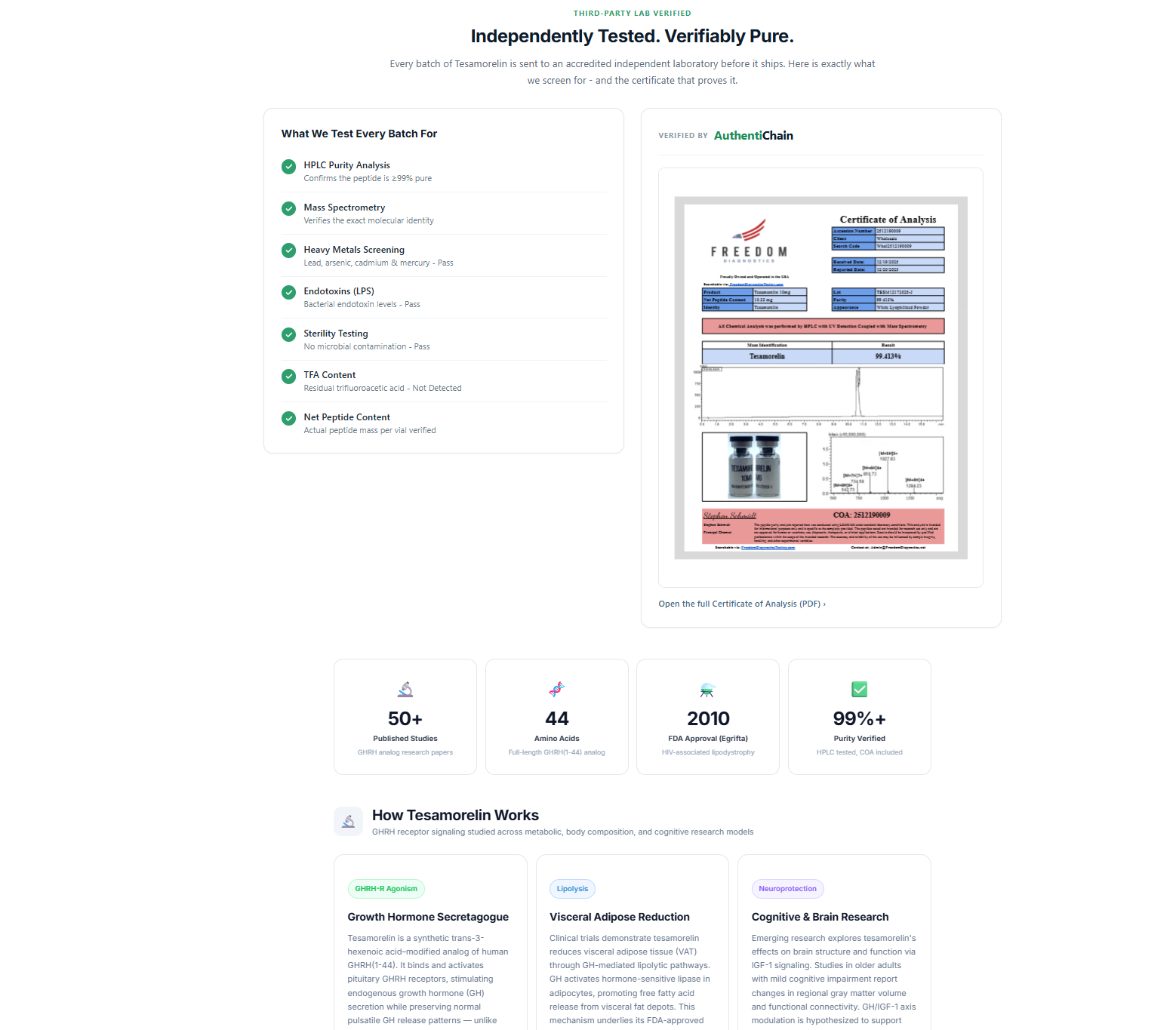
Independently Tested. Verifiably Pure.
Every batch of CJC-1295 (no DAC) is sent to an accredited independent laboratory before it ships. Here is exactly what we screen for - and the certificate that proves it.
What We Test Every Batch For
How CJC-1295 (No DAC) Works
A short-acting modified GHRH(1-29) analog whose pharmacology mirrors a single endogenous GHRH pulse - rapid receptor activation, short circulation, and clearance within roughly half an hour.
Pituitary GHRH-R Activation
The sequence is GHRH(1-29) carrying the four canonical substitutions (D-Ala2, Gln8, Ala15, Leu27) that confer resistance to DPP-IV and trypsin-like proteases. It binds the GHRH receptor on anterior pituitary somatotrophs with potency comparable to native GHRH, activating Gαs-coupled adenylyl cyclase and the cAMP/PKA cascade that drives GH gene transcription and secretion (Frohman & Kineman 2002).
- Selective GHRH-R agonism on anterior pituitary somatotrophs
- Four substitutions block proteolytic inactivation in vitro
- cAMP/PKA-mediated GH transcription and release
No DAC, No Albumin Anchor
Because the C-terminal maleimidopropionyl-lysine linker is absent, the peptide does not covalently bind serum albumin. Plasma half-life is short - on the order of ~30 minutes - with elimination dominated by renal clearance and residual peptidase activity. The result is a pharmacokinetic profile that approximates a single GHRH pulse rather than the multi-day exposure of CJC-1295 DAC (Teichman et al. 2006).
- No covalent albumin conjugation; no carrier-protein anchor
- ~30-minute plasma half-life vs. 5.8-8.1 days for DAC variant
- Clearance approximates native GHRH kinetics in preclinical models
Mimics Endogenous GHRH Pulses
The short half-life produces a discrete, pulsatile rise in GH that resolves within hours, rather than sustained elevation. This profile is widely paired in preclinical literature with a GH-secretagogue (e.g., ipamorelin) to study cooperative somatotroph activation, because GHRH-R and GHS-R agonism are synergistic on GH release (Sackmann-Sala et al. 2009).
- Discrete GH pulse rather than chronic receptor occupancy
- Commonly co-administered with GHRP-2 / GHRP-6 / ipamorelin in studies
- Useful tool for probing pulsatility, not flattened sustained exposure
What Research Has Shown
Reported pharmacokinetic and endocrine findings from peer-reviewed GHRH-analog studies
Research Applications
Primary in vitro and preclinical investigation areas
Pulsatile GH / IGF-1 Axis Research
Tool compound for probing acute GHRH-receptor activation and discrete somatotroph GH pulses. Used in preclinical models to dissect ligand-receptor pharmacology without the confound of sustained albumin-bound exposure characteristic of the DAC analog.
Teichman et al. 2006 ↗GHRH-R + GHS-R Synergy
Reference GHRH-R agonist for in vitro and preclinical co-administration studies with growth-hormone secretagogue receptor (GHS-R) ligands such as ipamorelin, GHRP-2, and GHRP-6. Used to characterize cooperative GH release from dual somatotroph pathway activation.
Sackmann-Sala et al. 2009 ↗DAC vs. No-DAC Comparator
Short-half-life counterpart to CJC-1295 DAC. Enables direct in vitro and preclinical comparison of acute vs. sustained GHRH-R agonism, isolating the contribution of albumin conjugation to peptide distribution, metabolism, and elimination.
Alba et al. 2006 ↗Pulsatility & Desensitization
Used to probe how pulsatile (rather than continuous) GHRH-R occupancy affects downstream IGF-1 production, somatotroph responsiveness, and receptor desensitization kinetics. A useful contrast to the sustained-exposure profile reported for CJC-1295 DAC (Ionescu & Frohman 2006).
Ionescu & Frohman 2006 ↗Compound Information
Technical specifications and analytical profile
Frequently Asked Questions
Common questions about CJC-1295 (no DAC) research parameters
Sources & References
Peer-reviewed publications and preclinical studies database