
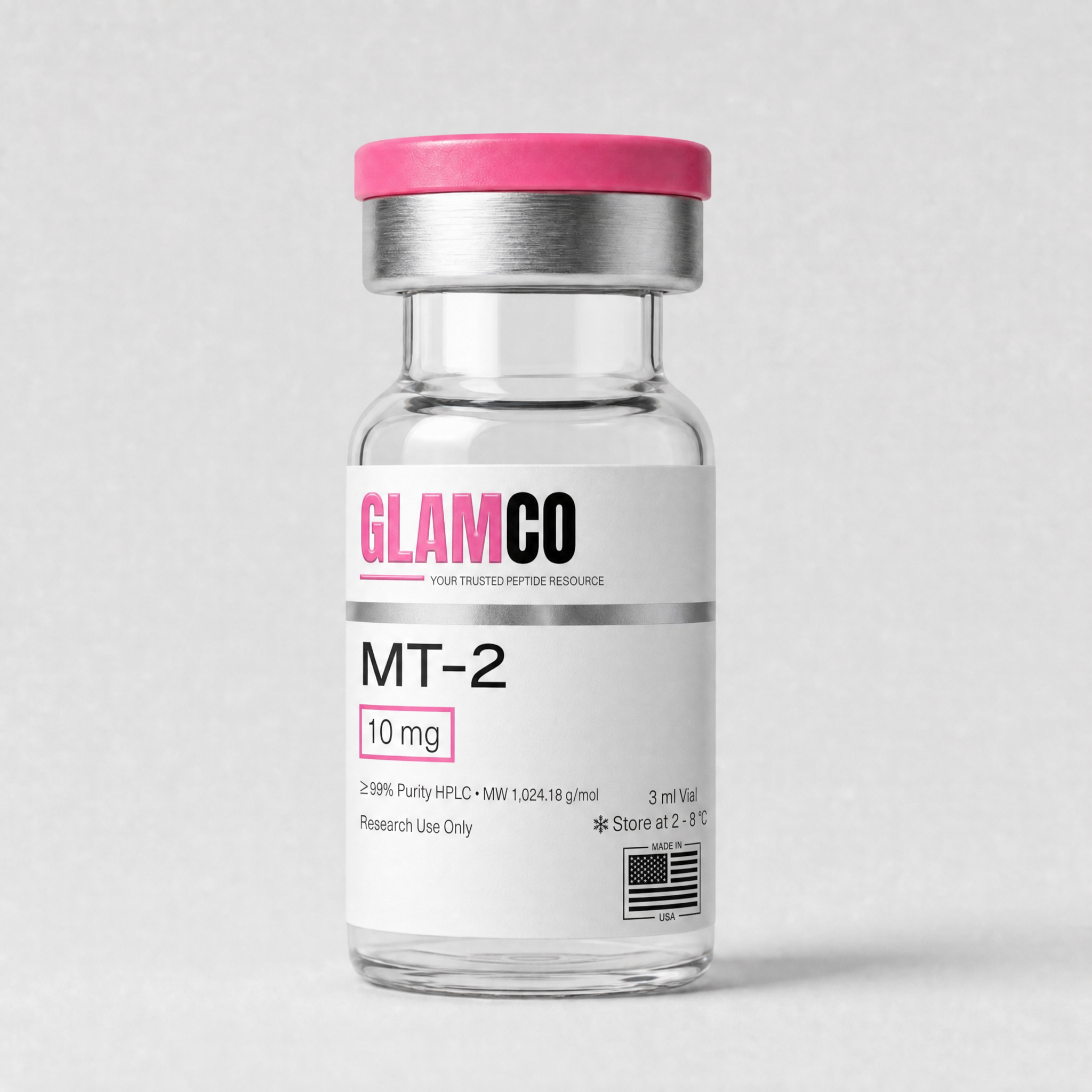
GlamCO Melanotan II
99%+ Purity
Verified by HPLC
Home / Catalog / Melanotan II

Melanotan II

$45.00
Made in USA
cGMP Compliant

Cyclic heptapeptide α-MSH analog (MT-II / MT-2), a non-selective MC1-5R agonist for in vitro melanocortin receptor research.

Tier Quantity Discount
Most Popular 3 - 5 10%
Max Savings 6 + 15%
Secure Checkout | Third-Party Tested | Free Shipping $100+
Sterility & Endotoxins PASSED
Net Content & Purity PASSED
Third-Party Lab Verified

Independently Tested. Verifiably Pure.

Every batch of Melanotan II is sent to an accredited independent laboratory before it ships. Here is exactly what we screen for - and the certificate that proves it.

What We Test Every Batch For
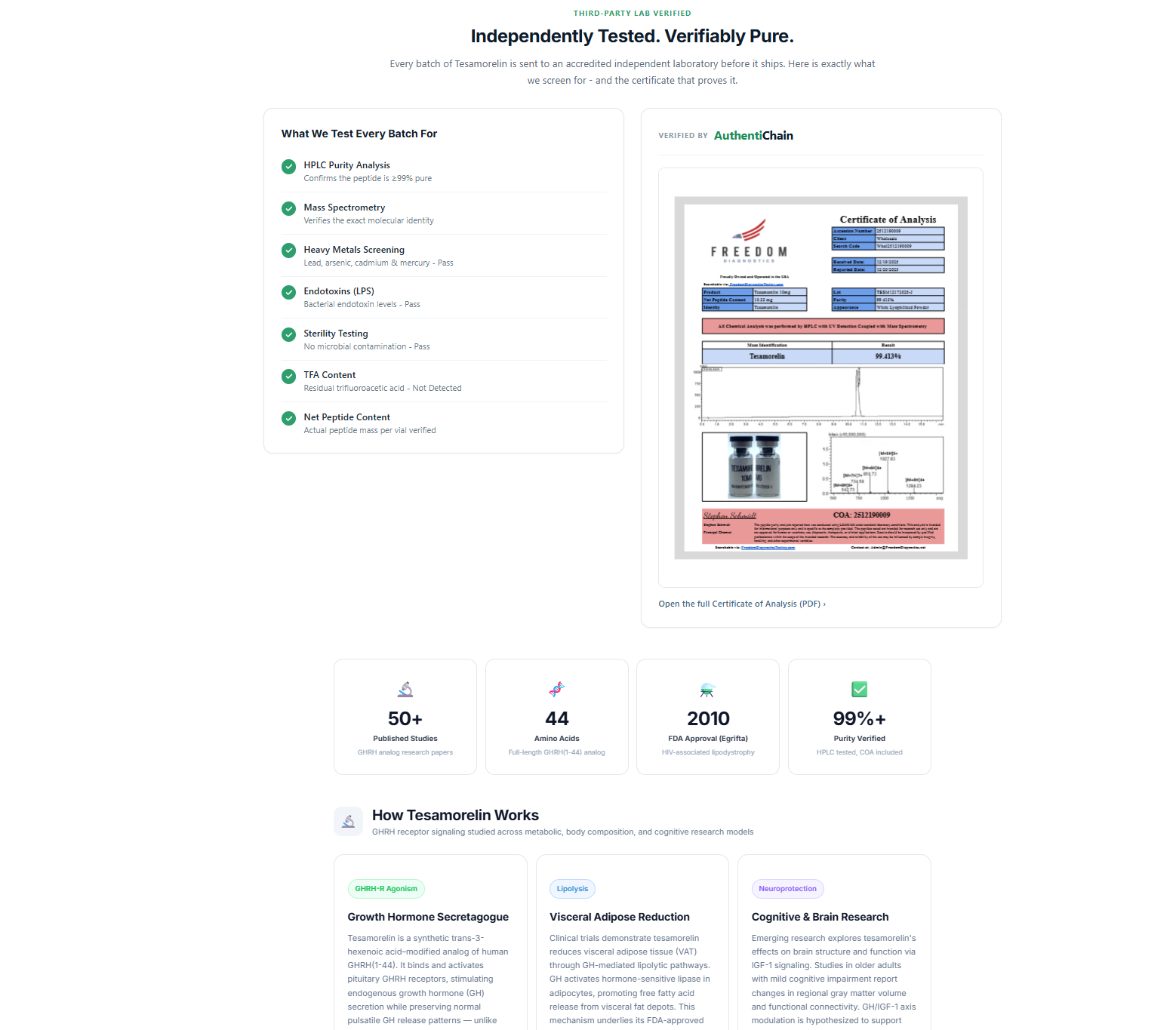
HPLC Purity Analysis
Confirms the peptide is ≥99% pure
Mass Spectrometry
Verifies molecular identity (~1024.18 Da)
Heavy Metals Screening
Lead, arsenic, cadmium & mercury - Pass
Endotoxins (LPS)
Bacterial endotoxin levels - Pass
Sterility Testing
No microbial contamination - Pass
TFA Content
Residual trifluoroacetic acid - Not Detected
Net Peptide Content
Actual peptide mass per vial verified
🧬
5
Melanocortin Receptors
Non-selective MC1R-MC5R agonist
7
Cyclic Residues
Lactam-bridged heptapeptide
📊
~1024
Molecular Weight (Da)
C50H69N15O9
🛡
99%+
Purity Verified
HPLC tested, COA included
Receptor Pharmacology

How Melanotan II Works

Melanocortin receptor signaling studied across pigmentation, energy balance, and CNS preclinical models

MC1R-MC5R Agonism

Non-Selective Melanocortin Receptor Agonism

MT-II is a non-selective agonist of all five melanocortin receptors (MC1R, MC2R, MC3R, MC4R, MC5R). As a superpotent cyclic analog of α-MSH(4-10), it activates downstream Gαs/cAMP signaling at MC1R (melanocytes) and MC3R/MC4R (hypothalamus) in preclinical models (Dorr et al. 1996).

  • Binds MC1R, MC3R, MC4R, MC5R with nanomolar affinity
  • Activates Gαs-coupled adenylyl cyclase / cAMP pathway
  • Greater potency and stability than native α-MSH
Cyclic Structure

Lactam-Bridge Cyclization & Receptor Affinity

A side-chain-to-side-chain lactam bridge between Asp&sup5; and Lys¹° constrains the [Nle&sup4;, D-Phe&sup7;]-α-MSH(4-10) backbone into a beta-turn conformation. This rigidification and the D-Phe&sup7; substitution dramatically increase enzymatic stability and receptor binding affinity (Al-Obeidi, Hadley, Hruby et al. 1989).

  • Heptapeptide cyclized Asp&sup5;-Lys¹° via amide bond
  • D-Phe&sup7; resists peptidase cleavage
  • Originally developed at University of Arizona
Melanogenesis

Melanogenesis & Pigment Cell Biology Research

MT-II activation of MC1R on melanocytes drives cAMP-dependent transcription of microphthalmia-associated transcription factor (MITF) and downstream tyrosinase, TRP-1, and TRP-2 expression, increasing eumelanin synthesis in murine B16 and human MNT-1 melanoma cell models (Abdel-Malek et al.).

  • cAMP / PKA / CREB / MITF signaling cascade
  • Upregulates tyrosinase & eumelanin biosynthesis
  • Standard tool in pigment cell biology research
Preclinical Findings

What Research Has Shown

Key findings from melanocortin receptor literature

MC1R Binding Affinity vs. native α-MSH (Dorr 1996) ~10x
Tyrosinase Activity in B16 Melanoma Cells ~3-5x
MC4R-Mediated Food Intake Reduction (Rodent) Dose-Dep.
Enzymatic Stability vs. linear α-MSH(4-10) Markedly ↑
Investigational Fields

Research Applications

Primary areas of MT-II investigation

Receptor Pharmacology

Melanocortin Receptor Pharmacology

MT-II is a benchmark non-selective agonist used to characterize MC1R-MC5R signaling, cAMP accumulation assays, and structure-activity relationships of subtype-selective ligands derived from the α-MSH(4-10) pharmacophore.

Dorr et al. 1996 ↗
Cell Biology

Pigmentation Cell Biology (B16 / MNT-1)

In vitro studies in murine B16 and human MNT-1 melanoma cell lines use MT-II to drive cAMP-dependent MITF transcription, tyrosinase induction, and eumelanin biosynthesis as a model of MC1R-driven melanogenesis.

Abdel-Malek et al. 2000 ↗
Energy Balance

Energy Balance Preclinical Research (MC4R)

Central administration of MT-II in rodent models reduces food intake and increases energy expenditure via hypothalamic MC4R activation, establishing the melanocortin system as a core regulator of body weight homeostasis.

Fan et al. 1997 ↗
CNS / Behavioral

CNS / Behavioral Preclinical Models

MT-II's CNS effects via MC4R underpin preclinical work on erectogenic responses (precursor research to bremelanotide / PT-141) and other neurobehavioral readouts in melanocortin receptor research models.

Wessells et al. 2000 ↗
Technical Specifications

Compound Information

Technical specifications and analytical profile

Chemical Name
[Nle&sup4;, D-Phe&sup7;]-α-MSH(4-10), cyclic lactam (Asp&sup5;-Lys¹°)
Sequence
Ac-Nle-cyclo(Asp-His-D-Phe-Arg-Trp-Lys)-NH₂
Molecular Weight
~1024.18 Da
Molecular Formula
C₅₀H₆₉N₁₅O₉
CAS Number
121062-08-6
Receptor Targets
MC1R / MC3R / MC4R / MC5R (non-selective agonist)
Form
Lyophilized powder
Purity
≥99% (HPLC verified)
Testing
Third-party HPLC, Mass Spec, Endotoxin
Storage (lyophilized)
-20°C for long-term stability
Storage (reconstituted)
2-8°C, use within 14 days
Solubility
Bacteriostatic water for reconstitution
COA
Included with every order
Common Inquiries

Frequently Asked Questions

Common questions about Melanotan II research parameters

MT-II is a cyclic heptapeptide with the sequence Ac-Nle-cyclo(Asp-His-D-Phe-Arg-Trp-Lys)-NH₂. It is derived from the [Nle&sup4;, D-Phe&sup7;]-α-MSH(4-10) pharmacophore and cyclized via a side-chain lactam bridge between Asp&sup5; and Lys¹°. The molecular formula is C₅₀H₆₉N₁₅O₉ with a monoisotopic mass of approximately 1024.18 Da.
Melanotan I (afamelanotide / [Nle&sup4;, D-Phe&sup7;]-α-MSH) is the linear, full-length 13-residue α-MSH analog, while MT-II is a shorter cyclic heptapeptide based on the α-MSH(4-10) pharmacophore. MT-II's lactam-bridge cyclization makes it a more potent, non-selective agonist across MC1R-MC5R, whereas MT-I retains a more α-MSH-like receptor profile.
MT-II is a non-selective agonist of the melanocortin receptor family (MC1R-MC5R). Receptor activation couples to Gαs, increases intracellular cAMP, and drives downstream PKA / CREB / MITF signaling. In melanocyte research models this upregulates tyrosinase and eumelanin synthesis; in hypothalamic MC4R models it modulates feeding, energy expenditure, and CNS behavioral readouts.
Substituting D-Phenylalanine for the native L-Phe&sup7; was a key Hadley/Hruby Arizona-lab innovation. The D-amino-acid stereochemistry resists peptidase cleavage and stabilizes the bioactive turn conformation around the "message sequence" His-Phe-Arg-Trp, increasing both metabolic stability and receptor binding potency by roughly an order of magnitude relative to native α-MSH.
MT-II is a standard tool compound in in vitro melanocortin pharmacology, including: HEK293 / CHO cells stably expressing MC1R-MC5R for cAMP and radioligand-binding assays, B16-F10 murine melanoma and MNT-1 human melanoma cells for melanogenesis studies, and rodent hypothalamic preparations for MC4R-mediated energy balance research. It is research-use only.
Lyophilized MT-II should be stored at -20°C for long-term stability and is stable at -80°C indefinitely. Once reconstituted in bacteriostatic water, store at 2-8°C and use within ~14 days. Avoid repeated freeze-thaw cycles, protect from light, and confirm reconstituted concentration by HPLC if used in quantitative receptor assays.
Academic Literature

Sources & References

Peer-reviewed publications and preclinical studies

PUBMED

Evaluation of melanotan-II, a superpotent cyclic melanotropic peptide in a pilot phase-I clinical study

1996 · Dorr RT et al. · PMID 8650169
View Source ↗
PUBMED

Role of melanocortinergic neurons in feeding and the agouti obesity syndrome

1997 · Fan W, Boston BA, Kesterson RA, Hruby VJ, Cone RD · PMID 9019399
View Source ↗
PUBMED

Synthetic melanotropic peptide initiates erections in men with psychogenic erectile dysfunction: double-blind, placebo controlled crossover study

2000 · Wessells H et al. · PMID 10843525
View Source ↗
PUBMED

The melanocortin-1 receptor is a key regulator of human cutaneous pigmentation

2000 · Abdel-Malek Z et al. · PMID 10885786
View Source ↗