
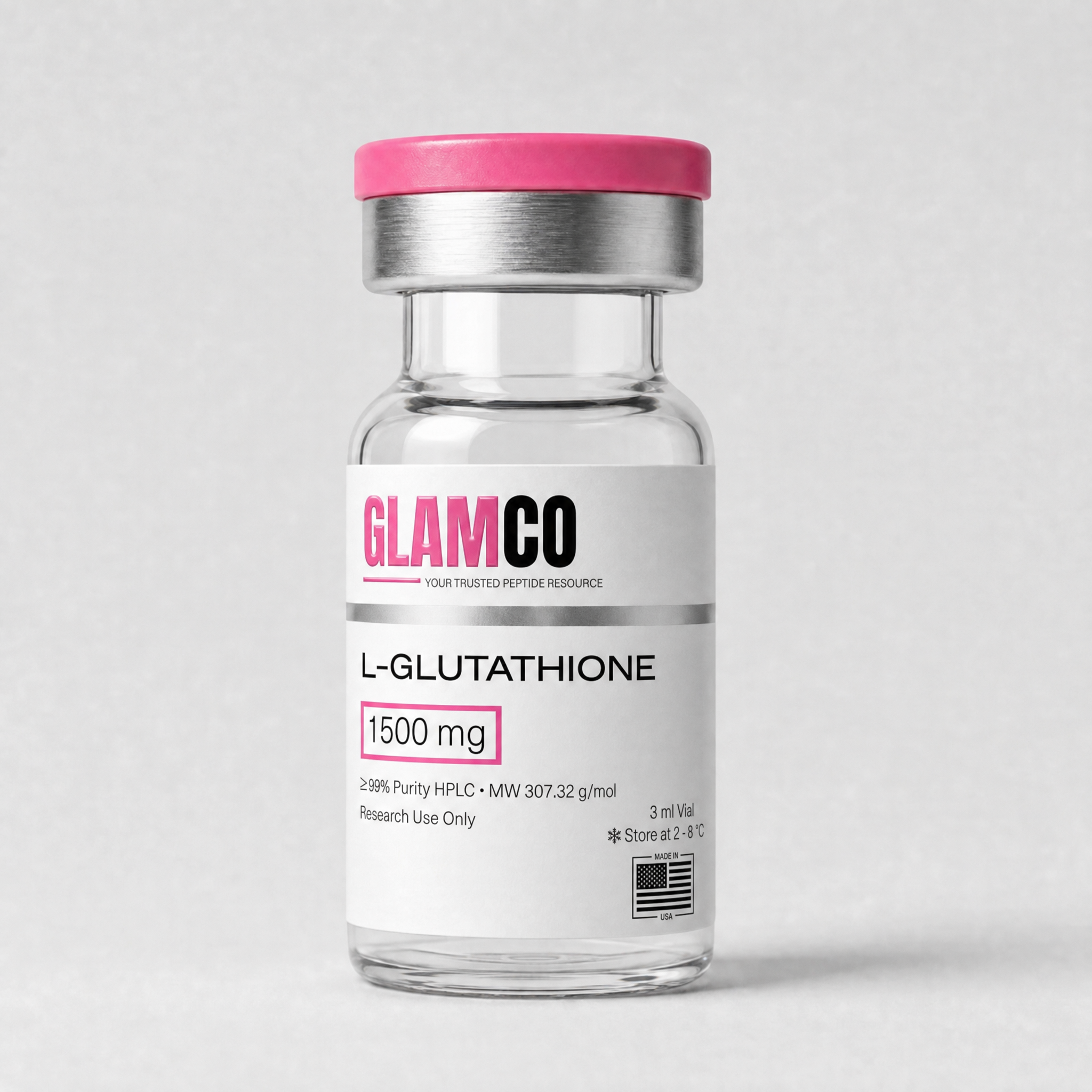
GlamCO L-Glutathione (reduced GSH) lyophilized research tripeptide
99%+ Purity
Verified by HPLC
Home / Catalog / L-Glutathione

L-Glutathione

$100.00
Made in USA
cGMP Compliant

L-Glutathione (reduced GSH) lyophilized intracellular tripeptide antioxidant (γ-Glu-Cys-Gly) for in vitro redox-biology research.

Tier Quantity Discount
Most Popular 3 - 5 10%
Max Savings 6 + 15%
Secure Checkout | Third-Party Tested | Free Shipping $100+
Sterility & Endotoxins PASSED
Net Content & Purity PASSED
Third-Party Lab Verified

Independently Tested. Verifiably Pure.

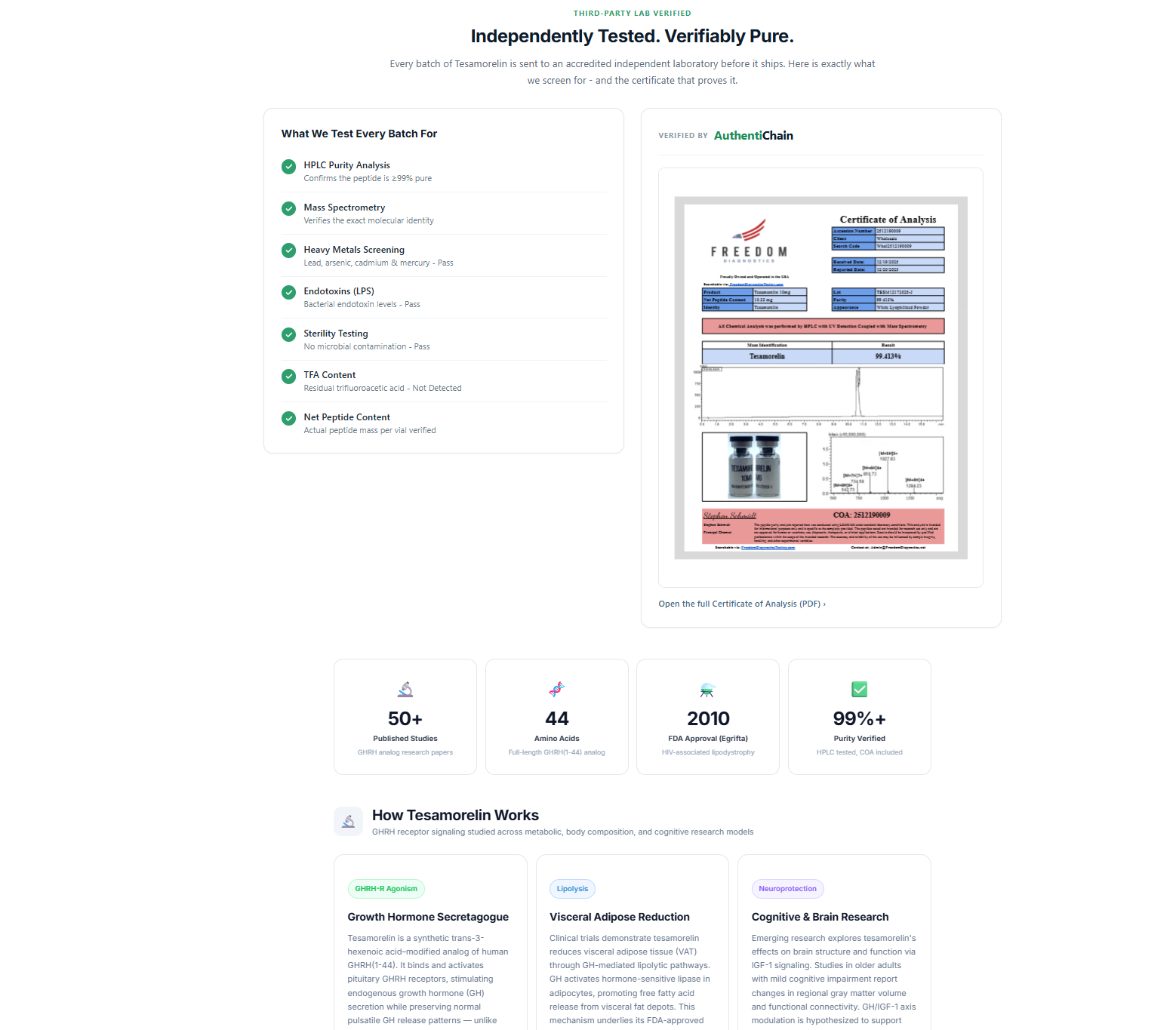
Every batch of L-Glutathione is sent to an accredited independent laboratory before it ships. Here is exactly what we screen for - and the certificate that proves it.

What We Test Every Batch For
HPLC Purity Analysis
Confirms the peptide is ≥99% pure
Mass Spectrometry
Verifies the exact molecular identity
Heavy Metals Screening
Lead, arsenic, cadmium & mercury - Pass
Endotoxins (LPS)
Bacterial endotoxin levels - Pass
Sterility Testing
No microbial contamination - Pass
TFA Content
Residual trifluoroacetic acid - Not Detected
Net Peptide Content
Actual peptide mass per vial verified
🧬
3
Amino Acid Tripeptide
γ-Glu-Cys-Gly linkage
⚗️
307.32
Molecular Weight (Da)
C₁₀H₁₇N₃O₆S formula
mM
Intracellular Range
Primary cellular thiol antioxidant
🛡️
99%+
Purity Verified
HPLC tested, COA included
Biochemical Mechanism

How L-Glutathione Works

Three converging redox pathways studied in cell-culture and biochemical research models

ROS Neutralization

ROS Scavenging & Redox Cycling (GSH↔GSSG)

The free cysteine thiol (-SH) on GSH donates electrons to reactive oxygen species, including hydrogen peroxide and lipid peroxides, generating oxidized glutathione disulfide (GSSG). Glutathione reductase regenerates GSH from GSSG at the expense of NADPH, maintaining the cellular GSH:GSSG ratio that defines redox potential (Lu, 2013).

  • Direct quenching of hydroxyl, peroxyl, and peroxynitrite radicals
  • Substrate for glutathione peroxidase (GPx) reducing H₂O₂ and ROOH
  • NADPH-dependent recycling via glutathione reductase (GSR)
Phase II Detoxification

Conjugation via Glutathione S-Transferase

Glutathione S-transferases (GSTs) catalyze nucleophilic addition of the GSH thiol to electrophilic xenobiotics, drug metabolites, and lipid-derived aldehydes (4-HNE). The resulting GSH-conjugates enter the mercapturate pathway for renal/biliary export, a central Phase II detoxification route (Forman et al., 2009).

  • Catalytic substrate for the GST enzyme superfamily
  • Detoxifies electrophilic drug metabolites & xenobiotics
  • Sequesters reactive aldehydes (4-HNE, MDA) in oxidative-stress models
Cellular Defense Network

Antioxidant Defense Pathways in Cell Models

GSH integrates with the wider antioxidant network: regenerating ascorbate and α-tocopherol, supporting peroxiredoxin/thioredoxin redox cycles via the Nrf2-driven gene program, and S-glutathionylating protein cysteines as a reversible post-translational redox switch (Aoyama et al., 2008).

  • Regenerates oxidized vitamins C and E in vitro
  • Couples to Nrf2/ARE-driven antioxidant gene expression
  • Reversible protein S-glutathionylation as redox signaling switch
Preclinical Outcomes

What Research Has Shown

Key preclinical findings from peer-reviewed glutathione literature

Intracellular GSH Concentration Range 1-10 mM
Healthy Cellular GSH:GSSG Ratio >100:1
Tyrosinase Inhibition (Melanogenesis Models) ~50% IC₅₀
Redox Homeostasis Maintained (in vitro) Active
Investigational Fields

Research Applications

Primary preclinical areas of L-Glutathione investigation

Redox Biology

Oxidative Stress Research

GSH is the dominant intracellular antioxidant in mammalian cells. Cell-culture models manipulate GSH levels (BSO depletion, exogenous GSH addition) to study ROS-driven apoptosis, ferroptosis, and lipid peroxidation, with the GSH:GSSG ratio serving as the canonical readout of cellular redox state.

Lu 2013 ↗
Hepatology

Hepatic Detoxification Pathways

The liver maintains the highest GSH concentrations in the body and is the principal site of GST-mediated Phase II conjugation. Preclinical models use GSH-depletion (acetaminophen, CCl₄) to study drug-induced liver injury, while GSH precursors (NAC, GSH ethyl ester) are studied as rescue agents.

Forman et al. 2009 ↗
Dermatology

Skin Pigmentation / Tyrosinase Research

In vitro and ex vivo melanocyte models report that GSH inhibits tyrosinase activity and shifts melanogenesis from eumelanin toward pheomelanin via thiol-mediated copper chelation, supporting GSH as a research tool compound in melanin-biology and skin-pigmentation cell models.

Sonthalia et al. 2017 ↗
Neuroscience

Neurodegeneration Preclinical Models

Brain GSH depletion is consistently reported in preclinical Parkinson's and Alzheimer's models. Neuronal GSH synthesis (via the EAAC1 cysteine transporter) and dopaminergic neuron vulnerability to oxidative stress are central research questions in cell-based and rodent neurodegeneration models.

Aoyama et al. 2008 ↗
Technical Specifications

Compound Information

Technical specifications and analytical profile

Chemical Name
γ-L-Glutamyl-L-cysteinyl-glycine (reduced glutathione, GSH)
Sequence
γ-Glu-Cys-Gly (tripeptide with non-canonical γ-peptide bond)
Molecular Formula
C₁₀H₁₇N₃O₆S
Molecular Weight
307.32 Da
CAS Number
70-18-8
Form
Lyophilized white powder
Purity
≥99% (HPLC verified)
Testing
Third-party HPLC, Mass Spec, free-thiol (Ellman's) assay, Endotoxin
Storage (lyophilized)
2-8°C short-term; -20°C for long-term, light-protected, desiccated
Storage (reconstituted)
2-8°C, use promptly; minimize air exposure to limit GSSG formation
Solubility
Freely water-soluble; reconstitute in degassed water or sterile saline
COA
Included with every order
Common Inquiries

Frequently Asked Questions

Common questions about L-Glutathione research parameters

L-Glutathione is the reduced form (GSH) of a tripeptide composed of γ-L-glutamic acid, L-cysteine, and glycine (molecular formula C₁₀H₁₇N₃O₆S, MW 307.32 Da, CAS 70-18-8). It is the most abundant low-molecular-weight thiol in mammalian cells, present at 1-10 mM intracellular concentrations, and functions as the central substrate for the cell's enzymatic antioxidant defenses. This product is research-use only.
GSH is the reduced, monomeric form bearing a free cysteine thiol (-SH). GSSG is glutathione disulfide, formed when two GSH molecules donate electrons to ROS and become linked via a disulfide (-S-S-) bridge. Cells maintain a GSH:GSSG ratio greater than 100:1 under physiological conditions; the ratio drops sharply under oxidative stress, making it the canonical readout of cellular redox state in research models.
GSH acts both as a direct radical scavenger (via thiyl-radical formation) and as the obligate reducing substrate for the glutathione peroxidase (GPx) family, which reduces H₂O₂ to water and lipid hydroperoxides (ROOH) to corresponding alcohols. The oxidized GSSG is recycled back to two GSH molecules by glutathione reductase, consuming NADPH supplied by the pentose phosphate pathway.
Lyophilized GSH should be stored desiccated at 2-8°C for short-term use or -20°C for long-term stability, protected from light. Once reconstituted in degassed water or sterile saline, refrigerate at 2-8°C and use promptly; minimize air exposure since dissolved oxygen will progressively oxidize GSH to GSSG. Avoid repeated freeze-thaw cycles.
Common in vitro applications include: oxidative-stress and ferroptosis cell-culture models (paired with BSO depletion or peroxide challenge), hepatocyte models of drug-induced liver injury, melanocyte tyrosinase-inhibition assays for pigmentation research, GST enzyme-activity assays (CDNB conjugation), and neurodegeneration models studying GSH depletion in dopaminergic neurons. Strictly research-use only.
The free cysteine thiol (-SH) on GSH is the same chemical handle that makes it a potent reductant - it is intrinsically reactive toward molecular oxygen, transition-metal contaminants, and other oxidants. Best practice: prepare fresh solutions in degassed/argon-purged buffers, chelate trace metals with EDTA, work on ice, and verify GSH:GSSG ratio with Ellman's reagent (DTNB) or HPLC at the start of each experiment.
Academic Literature

Sources & References

Peer-reviewed publications and preclinical studies database

PUBMED

Glutathione synthesis

2013 · Lu SC · Mol Aspects Med
View Source ↗
PUBMED

Glutathione: overview of its protective roles, measurement, and biosynthesis

2009 · Forman HJ, Zhang H, Rinna A · Mol Aspects Med
View Source ↗
PUBMED

Neuronal glutathione deficiency and age-dependent neurodegeneration

2008 · Aoyama K, Watabe M, Nakaki T · J Pharmacol Sci
View Source ↗
PUBMED

Glutathione as a skin whitening agent: facts, myths, evidence and controversies

2017 · Sonthalia S, Daulatabad D, Sarkar R · Indian J Dermatol Venereol Leprol
View Source ↗