

KLOW Blend
KLOW is a four-peptide research blend co-lyophilized for in vitro investigation of converging tissue-repair, inflammation, and extracellular-matrix pathways. Composition: KPV + BPC-157 + GHK-Cu + TB-500 - allowing study of NF-kappaB, VEGF, copper-ECM, and actin-thymosin pathways in a single experimental matrix.
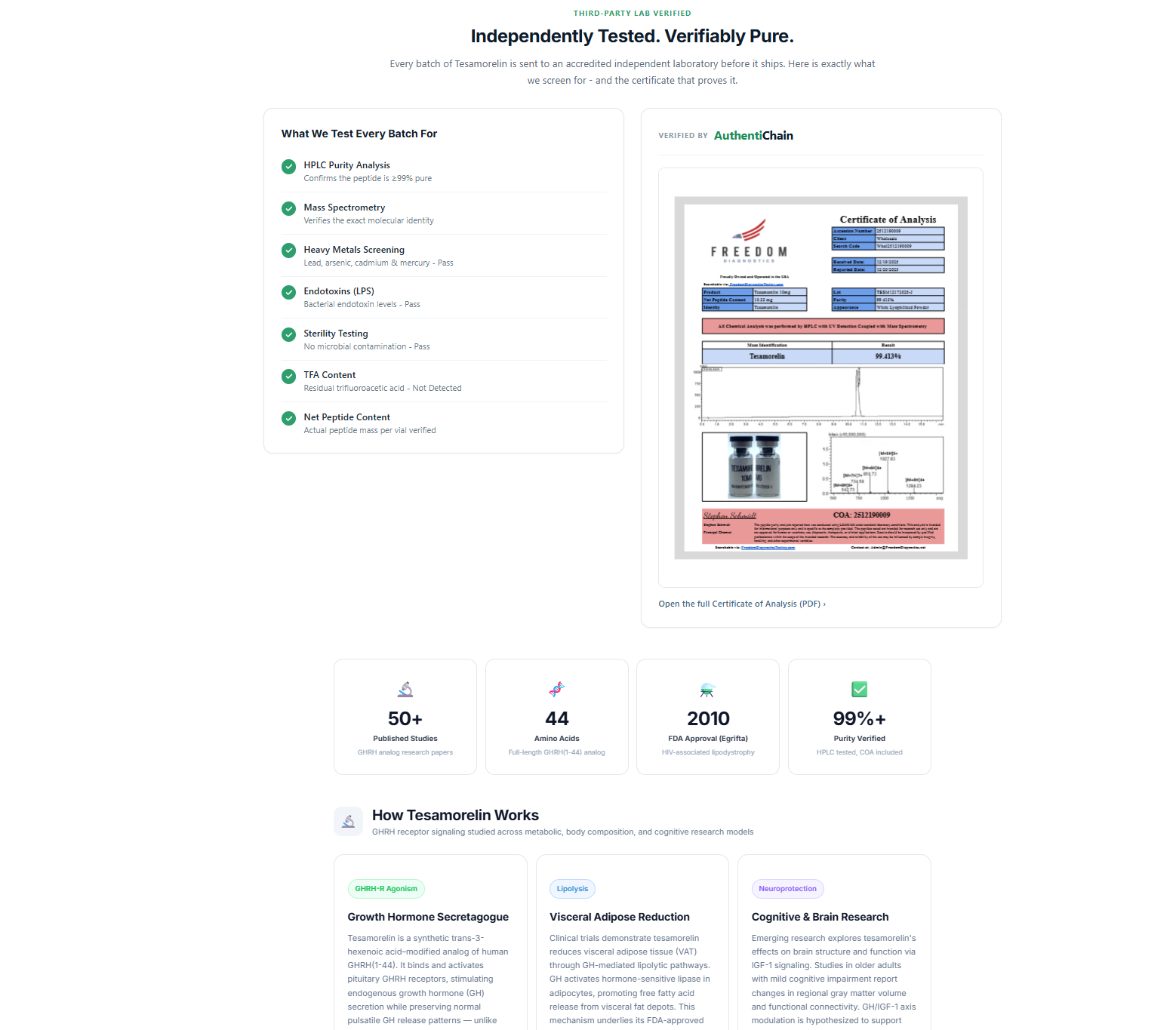
Independently Tested. Verifiably Pure.
Every batch of KLOW Blend is sent to an accredited independent laboratory before it ships. Each of the four constituent peptides - KPV, BPC-157, GHK-Cu, and TB-500 - is verified for identity, purity, and net content prior to co-lyophilization. Here is exactly what we screen for, and the certificate that proves it.
What We Test Every Batch For
How KLOW Blend Works
Four mechanistically distinct peptides studied for converging effects on inflammation, angiogenesis, extracellular matrix, and cytoskeletal dynamics
NF-kappaB Suppression
KPV (Lys-Pro-Val), the C-terminal tripeptide of alpha-MSH, has been reported in vitro to block the importin-alpha/p65 NF-kappaB nuclear translocation pathway, suppressing pro-inflammatory cytokine transcription independently of melanocortin receptors.
- Inhibits NF-kappaB nuclear import
- Reduces TNF-alpha and IL-1beta signaling in models
- Studied in colitis and dermatitis research models
VEGF & Nitric Oxide Pathways
BPC-157, a 15-amino-acid fragment derived from gastric Body Protection Compound, is reported in preclinical models to upregulate VEGFR2, modulate the nitric oxide system, and influence angiogenic and gut-barrier signaling.
- Upregulates VEGFR2-driven angiogenesis in vitro
- Modulates eNOS and NO-system signaling
- Studied in tendon, ligament, and gut-barrier models
Copper-Tripeptide ECM Signaling
GHK-Cu (Gly-His-Lys-Cu2+) is a copper-binding tripeptide reported to modulate gene expression related to collagen synthesis, decorin, antioxidant defense, and extracellular matrix remodeling in dermal fibroblast cultures.
- Modulates collagen and decorin gene expression
- Studied in fibroblast and skin-equivalent models
- Reported antioxidant and matrix-remodeling activity
What Research Has Shown
Selected preclinical findings across the four constituent peptides
Research Applications
Primary domains of KLOW-component investigation
Gut Barrier Research
KPV and BPC-157 are both studied in intestinal-epithelial models for effects on tight-junction integrity, mucosal inflammation, and DSS-colitis paradigms - making KLOW a candidate matrix for studying combinatorial gut-barrier modulation in vitro.
Dalmasso et al. 2008 ↗Tight-Junction Research
BPC-157 and KPV literature describes effects on zonulin, occludin, and claudin expression in intestinal and epithelial barrier models, used to probe permeability changes under inflammatory challenge.
Sikiric et al. 2018 ↗Anti-Inflammatory Pathway Research
All four KLOW components have been studied for effects on NF-kappaB, cytokine release, and oxidative-stress markers, supporting investigation of multi-target inflammation pharmacology in cell and tissue models.
Pickart & Margolina 2017 ↗Combinatorial Peptide Pharmacology
KLOW serves as a research scaffold for studying additive or synergistic effects between distinct peptide pharmacologies (NF-kappaB, VEGF, copper-ECM, actin-thymosin) without requiring four separate reconstitutions.
Goldstein et al. 2005 ↗Compound Information
Per-component sequence, mass, and analytical profile
Frequently Asked Questions
Common questions about the KLOW Blend research matrix
Sources & References
Peer-reviewed publications and clinical studies database