

GLP2-TZ
GLP2-TZ (teduglutide-class peptide) is a DPP-IV-resistant GLP-2 analog supplied as a lyophilized powder for in vitro intestinotrophic and mucosal-research applications. The Gly² substitution extends preclinical half-life relative to native GLP-2.
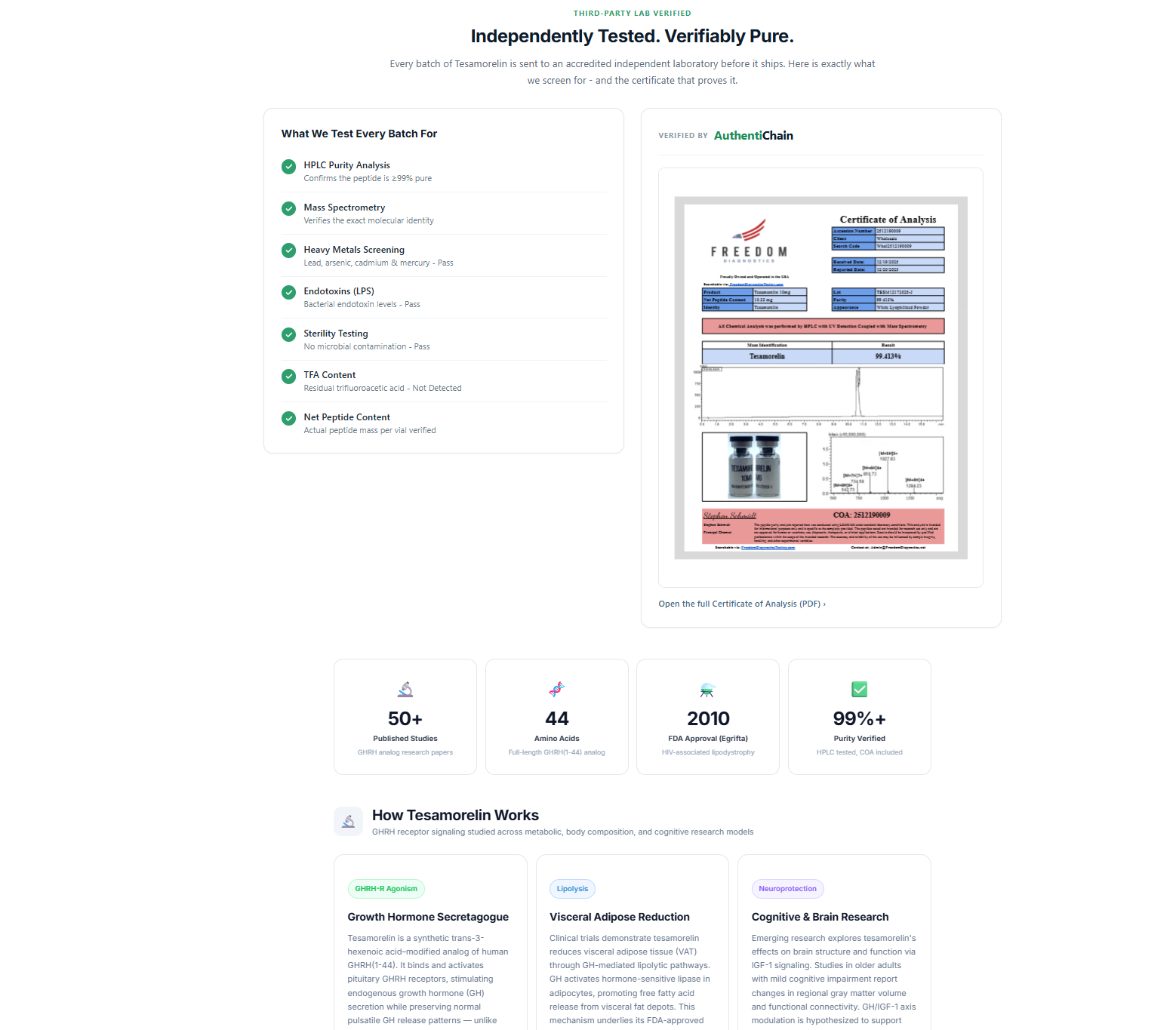
Independently Tested. Verifiably Pure.
Every batch of GLP2-TZ is sent to an accredited independent laboratory before it ships. Here is exactly what we screen for - and the certificate that proves it.
What We Test Every Batch For
How GLP2-TZ Works
GLP-2 receptor signaling studied across intestinotrophic, mucosal-barrier, and enteroendocrine preclinical research models
GLP-2 Receptor Activation
GLP2-TZ is a synthetic [Gly²]GLP-2(1-33) analog that binds the GLP-2 receptor (GLP-2R), a class B GPCR localized to intestinal subepithelial myofibroblasts, enteric neurons, and enteroendocrine cells. Receptor activation triggers downstream cAMP/PKA signaling that propagates indirectly to crypt enterocytes via paracrine mediators such as IGF-1 and ErbB ligands in preclinical models.
- Selective GLP-2R agonism on subepithelial fibroblasts
- cAMP/PKA second-messenger cascade
- Paracrine IGF-1 and ErbB-mediated effects on crypt cells
Gly² Substitution & Extended PK
Native GLP-2 is rapidly inactivated by dipeptidyl peptidase-IV (DPP-IV), which cleaves between Ala² and Asp³, yielding a preclinical plasma half-life of approximately 7 minutes. Substituting Ala² with Gly² blocks DPP-IV cleavage, extending the preclinical half-life to roughly 2 hours and enabling sustained GLP-2R engagement in research models.
- Ala² → Gly² blocks DPP-IV N-terminal cleavage
- Preclinical half-life ~2 h vs. ~7 min for native GLP-2
- Sustained receptor exposure in in vitro systems
Mucosal-Trophic Pathways
In preclinical rodent and in vitro intestinal models, GLP-2R activation increases crypt-cell proliferation, villus height, mucosal mass, and small-bowel weight. Research models additionally describe reduced enterocyte apoptosis, increased intestinal blood flow, and reinforced tight-junction barrier function.
- Increased crypt-cell proliferation and villus height
- Reduced enterocyte apoptosis in research models
- Enhanced barrier and tight-junction integrity
What Research Has Shown
Reported magnitudes from rodent and in vitro GLP-2 analog studies
Research Applications
Primary areas of GLP-2 analog investigation in preclinical and in vitro models
GLP-2 Receptor Biology Research
Tool for studying GLP-2R class B GPCR pharmacology, receptor localization on subepithelial fibroblasts and enteric neurons, and cAMP/PKA signaling dynamics in cultured intestinal cells.
Drucker & Yusta 2014 ↗Intestinal Adaptation Preclinical Studies
Rodent short-bowel and resection models use [Gly²]GLP-2 to probe intestinotrophic adaptation: villus elongation, crypt proliferation, and enhanced nutrient absorption following massive small-bowel loss.
Drucker et al. 1996 ↗Mucosal Barrier Research
In vitro and rodent models examine GLP-2R effects on tight-junction protein expression, transepithelial electrical resistance (TEER), and barrier integrity under inflammatory and ischemic challenge.
Benjamin et al. 2000 ↗Enteroendocrine Pathway Research
Investigations of L-cell co-secretion of GLP-1/GLP-2, paracrine IGF-1 and ErbB ligand release, and crosstalk between proglucagon-derived peptides in enteric and metabolic preclinical systems.
Rowland & Brubaker 2011 ↗Compound Information
Technical specifications and analytical profile
Frequently Asked Questions
Common questions about GLP2-TZ research parameters
Sources & References
Peer-reviewed publications and preclinical studies database