
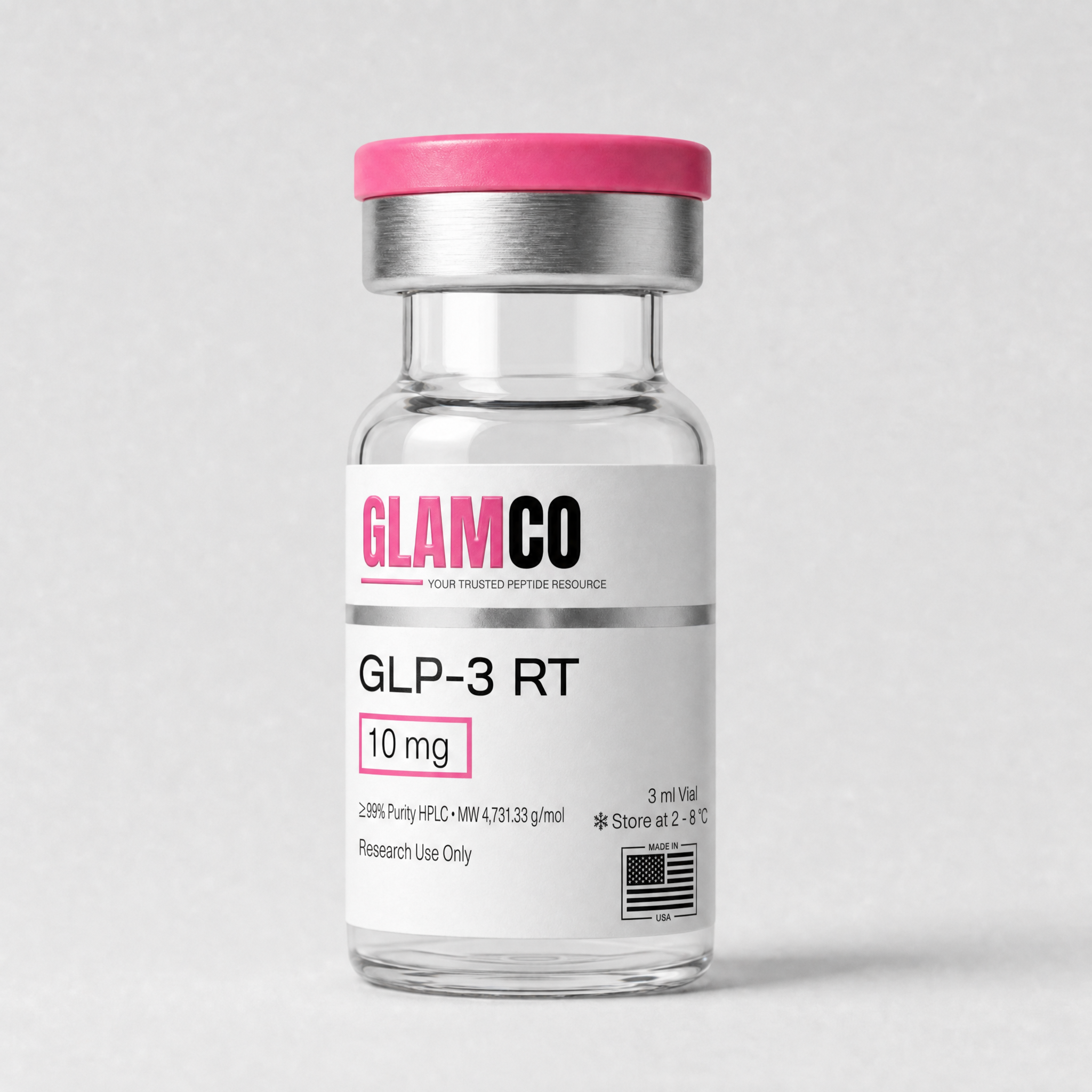
GLP-3 RT
GLP-3 RT is a triple-agonist research peptide active at the GLP-1, GIP, and glucagon (GcgR) receptors. Supplied as a lyophilized powder for in vitro metabolic-signaling research.
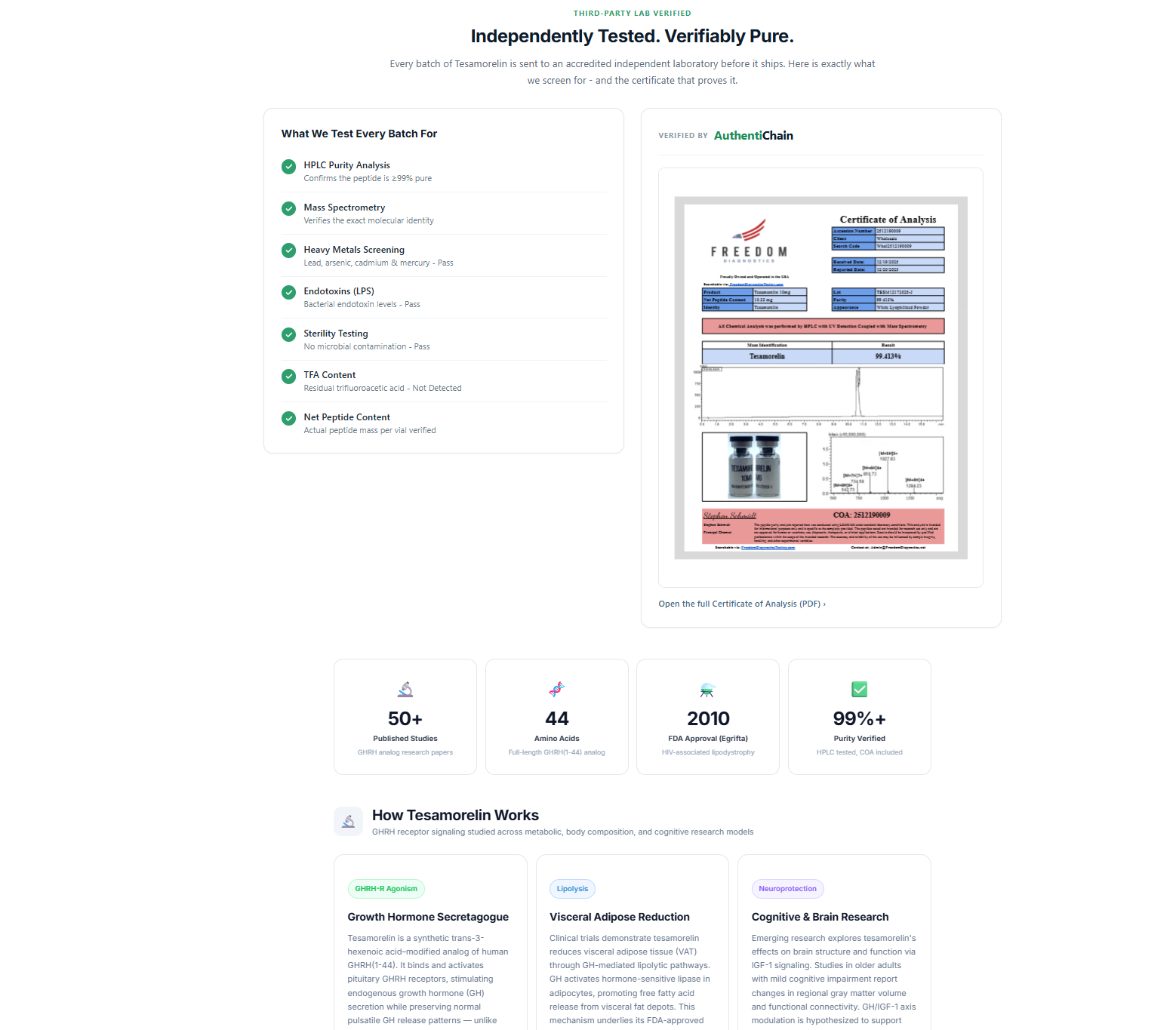
Independently Tested. Verifiably Pure.
Every batch of GLP-3 RT is sent to an accredited independent laboratory before it ships. Here is exactly what we screen for - and the certificate that proves it.
What We Test Every Batch For
How GLP-3 RT Works
A single 39-residue peptide engineered to engage three incretin/glucagon-family receptors with a fatty-acid acyl tether for extended pharmacokinetics
GLP-1R / GIPR / GcgR Co-Activation
The compound functions as a single-molecule agonist at three Class B GPCRs: the GLP-1 receptor, the glucose-dependent insulinotropic polypeptide (GIP) receptor, and the glucagon receptor. Relative to endogenous ligands, in vitro potency is approximately 0.4x at GLP-1R, 8.9x at GIPR, and 0.3x at GcgR (Coskun et al. 2022).
- Single peptide, three Class B GPCR targets
- GIPR-biased potency profile vs native hormones
- Glucagon-receptor arm adds energy-expenditure signaling
C20 Fatty-Diacid Acyl Conjugation
A C20 fatty diacid moiety is attached to Lys17 via an AEEA-gammaGlu linker. This acyl tether drives non-covalent binding to serum albumin, extending circulating half-life and supporting once-weekly dosing in preclinical and clinical pharmacokinetic studies.
- gammaGlu-AEEA spacer + C20 diacid (Lys17)
- Non-covalent albumin binding extends t-half
- Aib at positions 2 and 20 confers DPP-4 resistance
Energy Balance & Glucose Pathways
In diet-induced obese rodent models, triple agonism drives greater fat-mass loss than matched GLP-1/GIP dual agonism, attributed to glucagon-receptor-mediated effects on hepatic lipid handling and energy expenditure layered on top of GLP-1/GIP-driven satiety and insulinotropic signaling.
- Additive fat-mass reduction over dual agonism
- GcgR arm activates hepatic lipid oxidation pathways
- Tool compound for energy-expenditure mechanism studies
What Research Has Shown
Reported endpoints from published preclinical and Phase 2 datasets
Research Applications
Primary in vitro and preclinical research areas for triple-agonist incretin peptides
GLP-1R / GIPR / GcgR Pharmacology
Used as a tool compound for cell-based assays characterizing potency, signaling bias, and downstream cAMP/beta-arrestin recruitment across the three Class B GPCRs simultaneously engaged by a single ligand.
Coskun et al. 2022 ↗Metabolic-Disorder Animal Models
Diet-induced obese (DIO) rodent, db/db, and high-fat-diet rat models support investigation of body composition, glycemic control, and hepatic lipid endpoints under triple-agonist exposure compared with mono- and dual-agonist controls.
Coskun et al. 2022 ↗Body Composition & EE Research
Glucagon-receptor activation layered on top of GLP-1/GIP agonism provides a model system for dissecting fat-mass loss, lean-mass preservation, and resting energy expenditure in metabolic-phenotyping studies.
Jastreboff et al. 2023 ↗Multi-Agonist Incretin Design
Reference scaffold for medicinal-chemistry programs exploring uni-molecular poly-pharmacology at incretin/glucagon receptors, including comparisons against tirzepatide-class dual agonists and GLP-1 mono-agonists.
Rosenstock et al. 2023 ↗Compound Information
Technical specifications and analytical profile
Frequently Asked Questions
Common questions about Tesamorelin research parameters
Sources & References
Peer-reviewed publications and clinical studies database